

ARTIST CONVO: NAHOM GHIRMAY
DISCUSSING THE IDEA OF HOME, HABESHA INFLUENCE, AND HIS RECENT GALLERY SHOW, “TRACING THE INNER CHILD”
INTERVIEW & PHOTOGRAPHY BY MERON MENGHISTAB
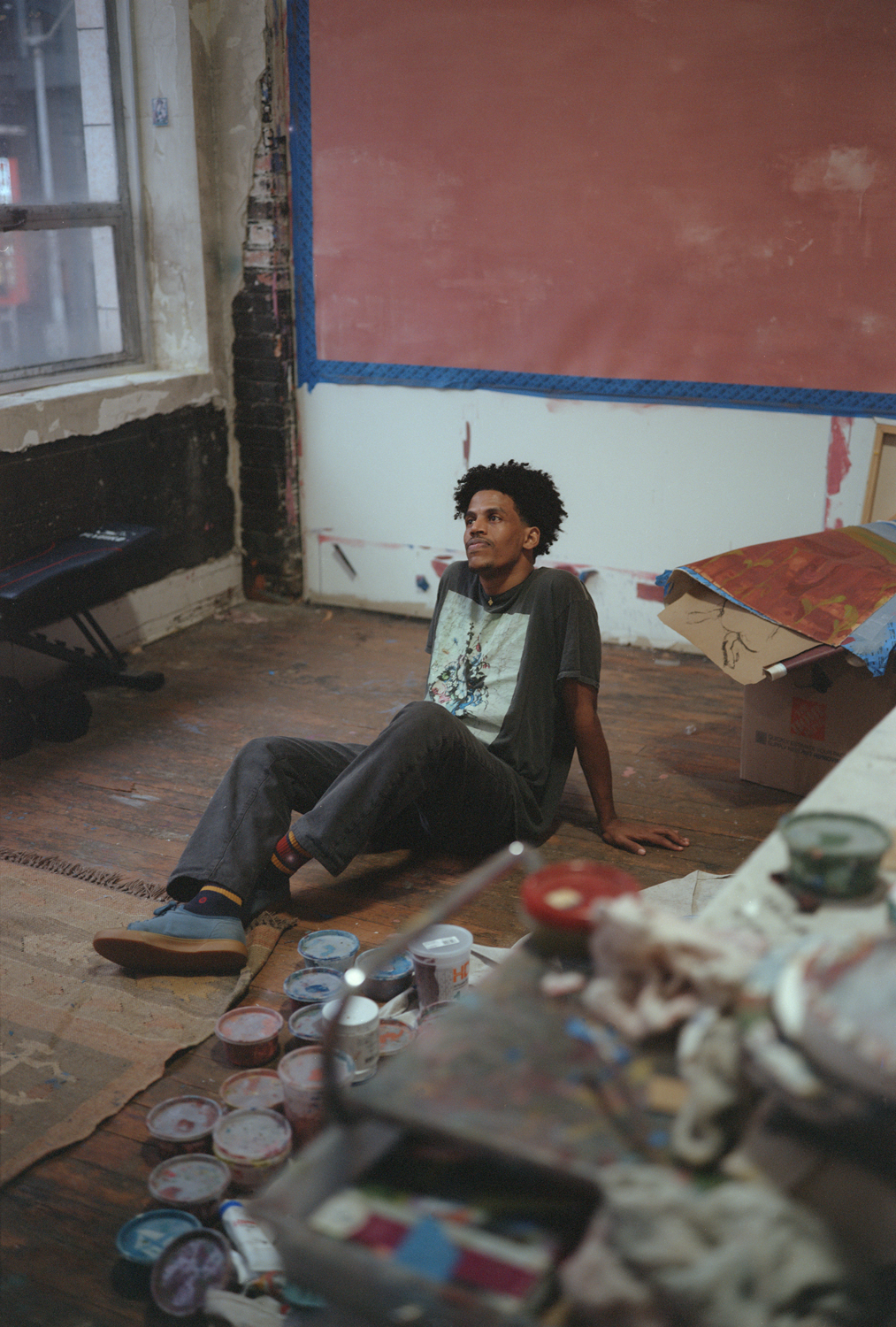
When local artist Nahom Ghirmay told me his studio was tucked away in downtown Seattle, I was excited to see where he’d managed to snatch up space in the city’s most stuck-in-purgatory neighborhood. Seattle artists’ fight to keep creatives, well, creating, is at its most obvious when you see how Nahom and perhaps a dozen other artists have managed to create a home for their ideations above the old Bergman Luggage building, which has become the home of Base Camp Studios 2.
Before I could even sit down, Nahom offered to get me coffee and one of the three water bottles he had tucked away in his studio; we settled in to discuss his most recent show at TASWIRA Gallery, titled “Tracing the Inner Child.” We also discussed the concept of home.
Before jumping into this article, though, I would be remiss if I didn’t mention to you, reader, how much I valued getting to interview a fellow Eritrean contemporary artist who has been influenced by the Pacific Northwest. Although the internet has brought together diasporas in ways an 18-year-old Meron from Eritrea/Columbia City would never understand (I was a deeply skeptical teenager), I hope we can continue to see the proliferation of one of Seattle’s largest immigrant communities in all forms of art.
“SEPTEMBER’S TREASURE 2” - NAHOM GHIRMAY, 2021
The following has been edited for length and clarity.
Meron Menghistab: How old were you when you moved here?
Nahom Ghirmay: I was a preteen.
MM: Did you go to high school in America at all?
NG: I went to high school here as a sophomore. Garfield High School is where I started getting into painting — before that, I was just drawing. I took the basic art class, and I really loved it.
I was in Sudan before here, for over four years. And I took the long journey to get here: I came through Mexico, and the Darién Gap, so yeah, when I got here, it was like, You have to get your shit together and jump into the work. Taking that art class helped me to just process and just stay grounded. I took art pretty much every semester afterward; I took AP Art, and then another AP art program.
MM: So then after high school, were you just interested in painting and continued making work?
NG: When I was in high school, I took those classes, but I was also not aware of how the high school system or the college system work. I didn't even go to my counselor until maybe after two semesters. I didn't know. So my art teacher — Ms. Hungate-Hawk — and I, we got very close; she was very supportive. She gave me my first easel. I would go to her class after school. Mentally, that really helped me. And she told me to pursue art, and I was very excited about the potential that I could do that. So I started building my portfolio during the first AP class, trying different mediums, like trying oil for the first time.
MM: It's interesting: You have to explore through different ways of making stuff when you're starting. The way I look at it, you have to find what medium talks at the same speed as your brain.
NG: That's also how I think. I was drawing before painting; I was anxious whether my ability to draw was going to transfer to painting. It’s funny: I was looking over my Facebook page the other day, and I found this question that I posted on Facebook to an art forum back in 2011, asking whether I’d be able to pick up painting — I also went on YouTube to learn.
Cornish had an open college team, where you could come with your portfolio and they’d critique it. One of the people there told me I should apply to the Art Institute of Chicago. That was cool to me, because it was clear art is a universal language where I didn’t have to abandon my past or my identity. I could still be me without having to start from scratch.
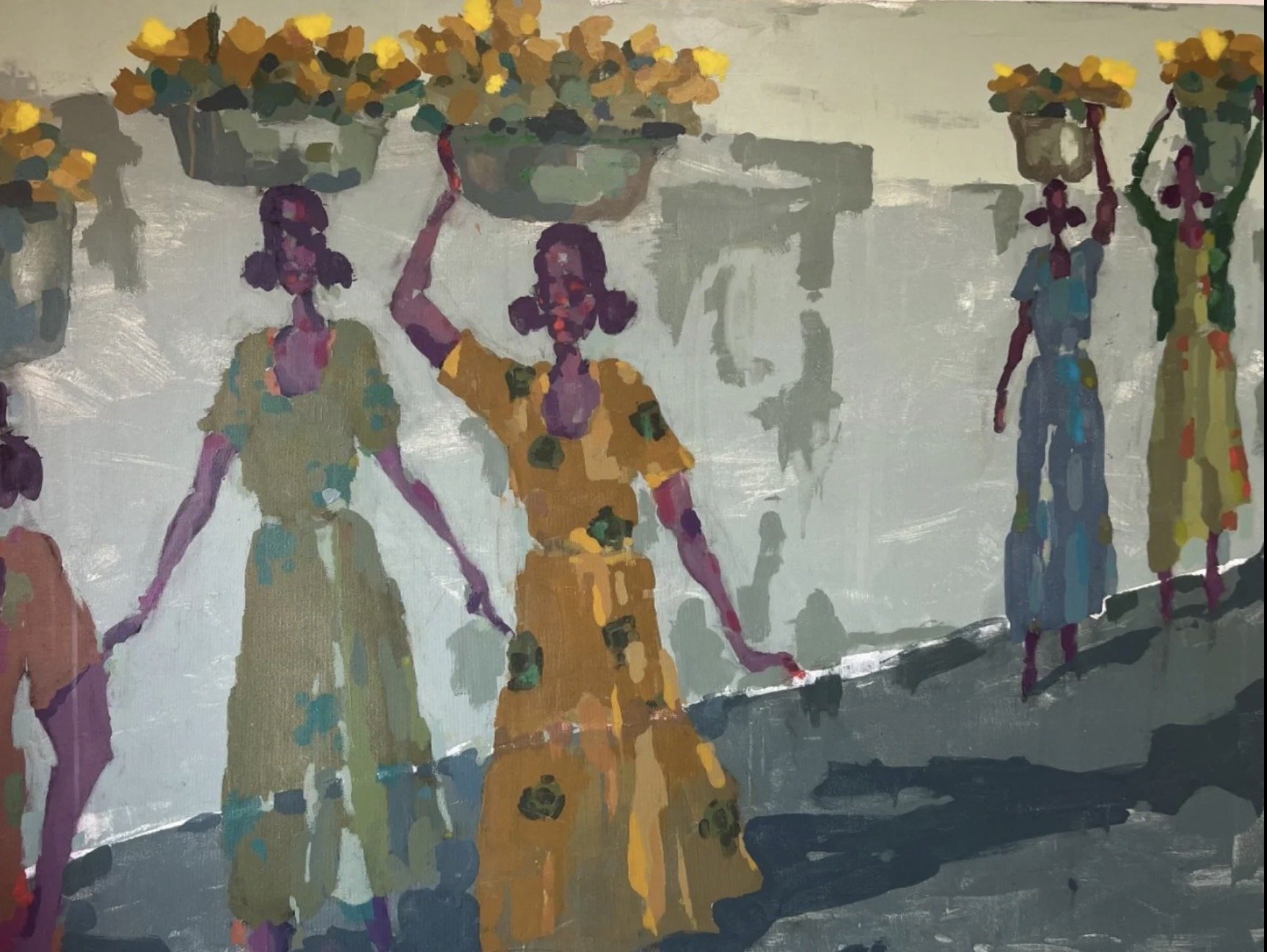
“THE HARMONIC JOURNEY” - NAHOM GHIRMAY, 2022
MM: When I think about Habesha art or art from the Orthodox Church, there’s this softness to the way people are drawn. I wouldn’t say your art necessarily looks like that, but you grew up in Asmara, so I imagine that art influenced you. I know that color palette influenced me. Do you sense that Habesha art affected your work? Or where do you see your work in conversation with that canon?
NG: I think it’s different [from my work], but I think it’s part of me. As far as the color palette goes, I did do traditional cultural pieces starting out, and moved from that into finding my own style. But yeah, it’s always going to be part of who I am as an artist.
MM: The reason I asked that question is, I saw you had that installation art piece that featured colorful stones. It reminded me of beles, and I was wondering what it meant!
NG: I like that interpretation. It was inspired by the spice markets. The idea was titled “Colors of Community”: The Seattle Office of Arts and Culture had a boot camp for public art. I was trying to show what it’s like to go to the market and how I remember home. In my memory, something that stands out is all the colors people wear with their different clothes.
MM: Do you feel like there’s a throughline of how you are remembering home? When I look at your work, it has a dream-state-like quality. You’re not asking for hard lines: Proportions are stretched in interesting ways. I’m curious if that comes from the ways you think about home when you’re making work.
NG: That’s kind of the big question I struggle to understand, because I left Eritrea as a child. Then I was in Sudan, then at a very young age, my reality got shocked, and my world was no longer just my neighborhood. Then I went to Latin America, all within a span of five, six years. That was during a foundational time of my growth, so, to me, the idea of home was not static. I think there is a state of home that I would like to be in that my painting is mostly yearning for.
We were in Sudan for five years. In retrospect, that state of [transit] means you don’t get attached to anything, because you have the idea, Oh, I’m gonna go somewhere. There are people who live for 20, 30 years in that mindset. You think, Oh, this is gonna pass.
MM: Right, this is in retrospect with an adult mind, but do you think that through your work, you’re realizing how you’re processing that?
NG: I do. After three or four years, things started to click. I got some clarity about how I think in a certain way, and even how I cope. For the past three years, I’ve been working on this series called “The Inner Child.” That was born from that question of, How do I cope?
When I go through stuff, or if the physical state is uncomfortable, I usually go and think about the place, and remember that it’s temporary, and that there are other versions of me. It’s attached to the perspective of migration, where you can view yourself in different ways, in different times. That helped me not get too attached with whatever negative situation was going on.
MM: The silence of a studio can also be a therapist. It’s like you’re sitting with your thoughts, as well as the act of making work.
NG: I think sometimes more than the act, you can come here, not do anything, and just think. That’s a huge part of it. You might not feel like working, but you get to try and have clarity about yourself.
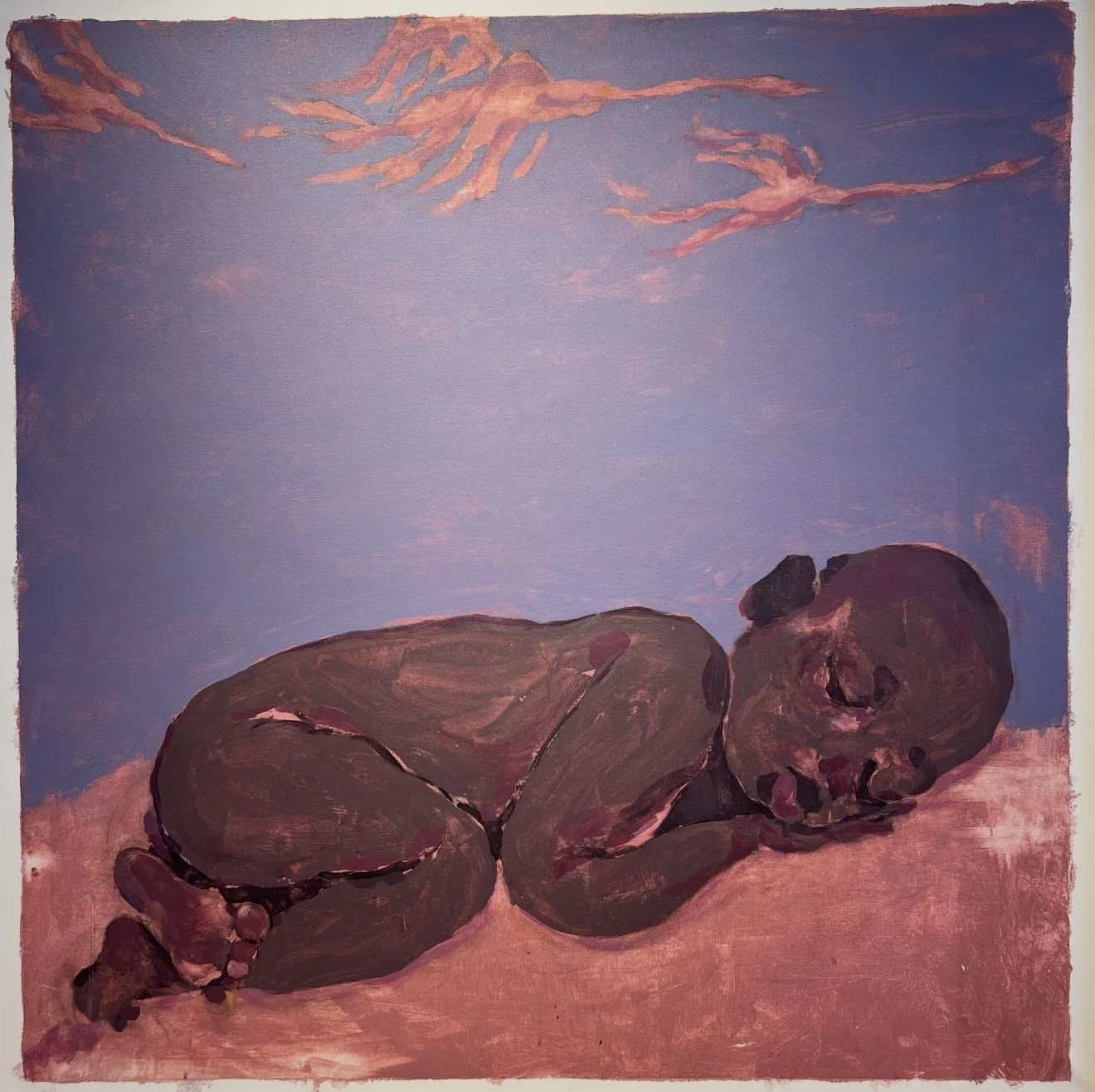
“UNTROUBLED SOUL” - NAHOM GHIRMAY, 2025
“I think the advantage of going through this migration was, I can almost ignore the physical world and go inside and try and think about a different home.”
“UNTITLED” - NAHOM GHIRMAY, 2025
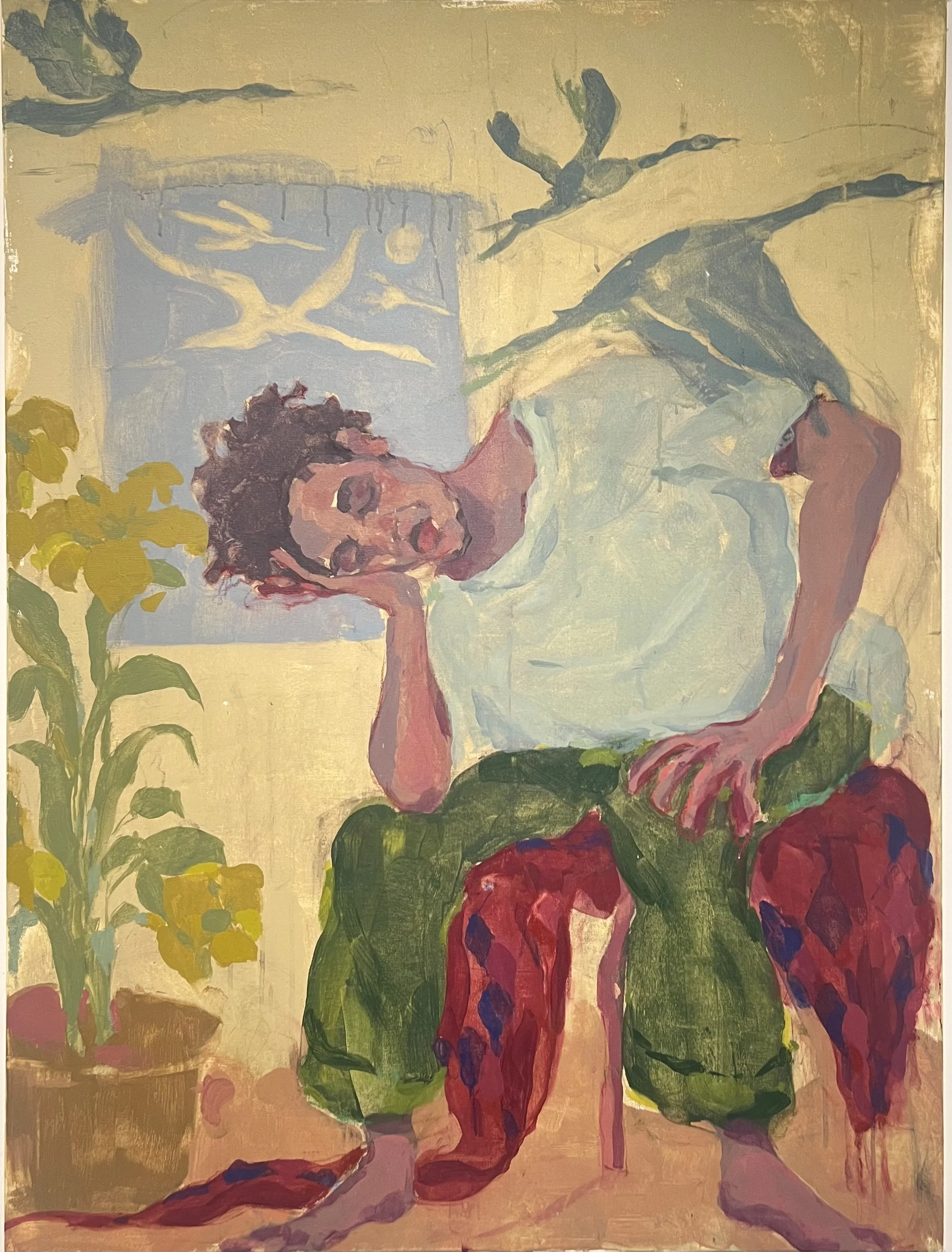
“DAYDREAM” - NAHOM GHIRMAY, 2025
MM: There are different levels of immigration status in the Habesha community. Do you feel like you’re having a reaction in your work, then, to what’s happening in America? I think things feel jarring to people in our community, as in any immigrant community.
NG: It’s a conversation I’ve had with many people. For a lot of us, this has been our lived experience, so it isn’t new within immigrant communities from an individual perspective. What feels different now is that the immigration issue has become a front-page sensation. The smearing and targeting of immigrants is happening on a bigger scale. A lot of people had a very wrong perception of how the immigration system works, but now, a lot of people are hopefully learning. There’s been a large gap in people’s knowledge about the immigration system.
MM: That’s a very nice way to say it.
NG: Blaming can be unproductive, too. You have a common enemy once you realize that people are not educated, and that someone on the top is not educating you. There’s a reason they don’t know.
MM: That’s a great point, “there’s a reason they don’t know.” Because we could talk about this for hours, let’s get back to the art: You had a great show recently at TASWIRA. A lot of your pieces are quite big. How do you think about scale? Do you think about the space that the works will be seen in, or do you just prefer to work in a large format?
NG: There are multiple layers that contribute to the motivation of going big. It was almost an evolution, because, for the most part, I previously worked on a smaller scale. Partially it’s because of the limitation of space — I was working in my living space — so when I got to a studio like this one, I felt like I could actually work in a larger format.
Your skills also have to shift. On a smaller scale, you have to move in a very controlled sense. When you go bigger, you change the way you approach. It becomes more challenging. So I think that made it more fulfilling.
After that [TASWIRA] show, I took a couple months to do sketches, and now I’m going back to do a continuation of the same series: It hasn’t moved from that topic of the inner child, home, and that dream-like state. Now I’m going to play with different settings in different colors, and see what kinds of feelings I get. I think the advantage of going through this migration was, I can almost ignore the physical world and go inside and try and think about a different home. I can just come here and think about whatever home is good for me, or what feels peaceful.
MM: The world can keep changing, but your home is your home.
NG: Especially after you move here, you feel trapped inside the apartment you’re in. I was joking with my friend the other day about how there are so many people here looking for people to talk to, and that there are whole villages basically living in these apartments, with everyone trapped in their own box.
I think this upcoming work is about not feeling trapped in a building or similar environment. It’s a reminder of how small you are, too, because in your apartment, you might feel too big. The next few pieces will continue on the idea of feelings and nature. The news and stuff sometimes makes you feel like everything is just going downhill. But then you go see the ocean: It’s still there, and it's still flowing, and you see the sky, and clouds are still growing. Now it’s even more important to go into that and see what the result will be.
NAHOM GHIRMAY IN HIS STUDIO, 2025
“SWIMMING UNDERNEATH THE MOONLIGHT” - NAHOM GHIRMAY, 2025
See more of Nahom Ghirmay’s work on his website.
Nahom’s work is available for purchase from TASWIRA Gallery.