

DINING AND
WRITING
KATIE LEE ELLISON INTERVIEWS DIANA LE OVER A TALL GLASS OF PINOT AT LENY’S TO TALK ABOUT GIRL NOISE PRESS
WRITTEN BY KATIE LEE ELLISON
PHOTOGRAPHY BY KK
Diana Le feels like That Girl. She’s stylish as hell, she doesn’t smile easily, she speaks succinctly and has a lot to say if asked, and she runs her own publishing house, Girl Noise Press.
She and the press caught my eye at the Seattle Art Book Fair at Washington Hall a few months ago, namely because I saw that among her titles and super cute merch, she had a collection from Vi Khi Nao. I found Vi Khi Nao years ago when I asked friend and fellow CHUM News contributor Ally Ang for some literary nonfiction book recommendations about suicide. Casual! Vi Khi Nao does in fact have a brilliant, experimental book called Suicide: The Autoimmune Disorder of the Psyche, and it scratched the very precise itch I had, which was to find some great books for a class I was teaching. So to see this very specific, prolific, and skilled author on a table with a slew of names I didn’t recognize, at a press I didn’t know, based in Seattle was a thrill. I bounded up to Diana to ask her a bunch of questions. It wasn’t enough. I needed to know more than I could find out over her book fair pop up.
So at Leny’s in Tangletown east of Green Lake, over the likes of Staind’s “It’s Been A While” and with a puppy eating french fries on top of the bar by our table, Diana and I got into it.
Diana started out in South Seattle, then moved to Bothell for middle and high school. That move meant that she went from listening to her brother’s rap and hip hop, to the “richer white suburb” tastes that introduced her to emo, metal, and punk. She went to UW, studied film, and got a job off Craigslist working for Mark Baumgarten, the former Editor at Large for City Arts Magazine (RIP). Baumgarten was working on a book about the history of the independent record label K Records out of Olympia, and hired Diana to transcribe interviews with its artists, including Bikini Kill, Miranda July, Mirah, Beck, and Modest Mouse. Those hours shaped Diana’s tastes, sending her deep into the riot grrrl scene and the lore surrounding the DIY punk scene in Washington.
This gig led to internships and jobs at The Stranger and Seattle Weekly (RIP), where she met Gwendolyn Elliot aka Gwen, the Weekly’s then-music editor who took her under her wing. Eventually Diana would move on to more lucrative copywriting gigs, “climbing the corporate ladder” as she put it, but on her last day at the Weekly, Gwen left her a gift: a copy of My Body is a Book of Rules by Elissa Washuta, a former literary legend in Seattle, now a professor in Ohio and still writing great books. Note: This move to the midwest is not singular. We lost Tara Atkinson, one of four who made up the incredible team behind the now-defunct Seattle reading series APRIL, to Iowa City, and Alayna Becker, comedian, writer, and managing editor at Moss, who is now an awarded nonfiction student there working on her thesis. Saeed Jones left New York City for Columbus, Ohio years ago, and Melissa Febos and her poet wife Donika Kelly left NYC for roles also in Iowa City. Just this summer, Elena Passarello left her beloved students in Oregon for those same prairies. And those are just the ones off the top of my head. This will be relevant to Diana. Keep reading.
Five years ago, Diana started Girl Noise Press and the first book was her own. For better or worse, I come from an MFA background heavily influenced by the elitist culture that taints the publishing industry and the literary world, so Diana’s sheer confidence and self-assuredness to write and publish her own memoir before the age of 30 reads to me as truly punk. In someone else’s hands, it could be cringe, but when you hear Diana tell it, it’s nothing but inspiring.
Her memoir, Suburban Legend, is clearly inspired by Washuta’s My Body is a Book of Rules; it’s fragmentary, it’s raw, and as her first and fired editor told her, it’s full of anger from deep inside the traumatic experiences it describes. Le’s book reminded me of Washuta’s tonally, structurally, and in content. She layers interviews with her mom, with memories of childhood abuse, with Vietnamese family history, with her coming-of-age sexual awakening and rage in the Y2K era. Her first editor told her what we so often hear in MFA programs: You have to be “healed” from or “over” your experiences before you can write about them. But Diana knew then and knows now, that simply isn’t it. Years ago, over coffee, I got to talk to Washuta about how I struggled to write because I couldn’t see past the pain of the things I was writing about, and those were her words of wisdom then as well: Use the pain. Write from inside it. I was in my early 30s and needed Elissa to give me permission to my face, while Diana knew the same thing instinctively, years younger, and from reading her book.
It’s this clarity of vision and this sharp instinct that has guided every publishing and business decision she makes for Girl Noise. For example, she takes a 50/50 split with all of her authors because, “It’s just fair, you know?” There’s a lot to read about all this, and every situation varies, but at most publishing houses, an author can expect between five and 20 percent of royalties, after their book has earned back any advance. At Girl Noise, there is no advance, so authors earn out immediately. “I will never take a book out of print because it didn’t sell,” Diana told me while I dipped Leny’s perfectly spicy hot wings in a generic ranch, and I noted that in the publishing world, her printing ethics are nothing less than angelic.
“If it does become something I rely on for my income, I am scared that it will change my publishing choices. And then I will be no different than a [commercial] publisher.”
She does a lot to make this possible. She works a day job at a local ad agency she loves. This keeps pressure off the press, which she says feels essential to the way it runs. They are a team of two: herself and Kelsey Sipple aka Kels, her trusted editor also doing this job alongside other ways to keep the bills paid. And Asterism Books, an online bookstore and distributor specializing in independent presses, has been a great partner, she says.
Girl Noise continues to grow year over year, though they still operate at a loss. They had their first open call recently, and while Diana expected to take one, maybe two books, she found four she couldn’t pass up.
“I go back and forth on whether or not I could get to a place where I could do it all the time. On the one hand, that's the dream,” she said. “But it also scares me because, if it does become something I rely on for my income, I am scared that it will change my publishing choices. And then I will be no different than a [commercial] publisher.”
Indeed, it would change the press entirely, because Diana’s tastes aren’t exactly the kind of books that sell big in airports. “I would say all of our books, they’re very intimate, they’re confessional, and they’re a little concerning,” she said. “Like, [they make you want to ask,] ‘Are you okay?’”
Somehow Diana has found a full stable of authors that fit this very specific aesthetic of hers. Reading one after another from Annastacia Stegall, Catherine Broadwall, Victoria Hood, and Makayla Danielle Gay, the throughline in all these books is a kind of sweaty, sticky, bloody, almost claustrophobic atmosphere; this specifically young, feminine, alone-in-your-bedroom feeling. Diana’s authors and the books she chooses reminded me of Kathleen Hanna’s album Julie Ruin, recorded in her closet and bedroom at home in Olympia after Bikini Kill broke up and she got really sick with Lyme disease. Hanna used a cheap drum machine and other lo-fi instruments to record what she needed to, alone.
This is what first struck Diana about Elissa Washuta’s book: There are no rules except the ones you make. “I’m into writers who are taking artistic risks,” she told me, “whether it’s in form or content. And I’m really just looking for my friends and my weirdos.”
And she has found them. Authors have told her that, especially in Kels’ hands, they feel safe and that their work is beautifully developed. One of her recent authors was nervous after a really bad MFA experience (typical), and told Diana and Kels how comfortable they both made them feel, from Kels’ constructive comments and thoughtful feedback, to Diana’s marketing skills, and what she describes as a Type-A editorial calendar, all on a shoestring budget and tiny staff.
The press is a kind of contradiction in terms: a punk ethos with exacting execution. Girl Noise Press is an undiscovered diamond in this city and Diana is the pressure that made it. But of course, like all good things, Seattle may very well see it all go.
“I’m coming to this hard realization that, for as much as I love Seattle, I don’t know if it’ll love me back.”
When I asked how she’s coping with rising costs of living in this tech-riddled city, and if she’s felt the pains of losing weird and wonderful artists to other cheaper and artist-friendly towns, she said, “That’s been something I’ve been thinking about, and it’s been affecting me, too.”
After swallowing a bite of her turkey club, she shared about tabling at the Detroit Book Fest and, confessing she hasn’t spent much time there, said Detroit felt like a good fit for what she’s doing. The city felt right, the people felt right, and the tenor of Girl Noise resonated there. In the brief time and conversations she had, she noticed, “it is just more affordable and hospitable for artists to be there.”
So likely within the next year, we’ll lose her and Girl Noise to the midwest as well, part of a growing cohort of artists who simply cannot afford these coastal cities, nor deal with the predictable gentrification and assimilation supported and funded by the tech industry’s wealth and homogenizing drive.
“I hadn’t really considered living anywhere else,” she said, “because I feel so lucky that I happened to grow up here. It’s so cool and beautiful. But then, I’m coming to this hard realization that, for as much as I love Seattle, I don’t know if it’ll love me back.”
If Girl Noise Press is a dream born from the time of the riot grrl scene, when, Diana reported, people showed up to DIY punk shows with homemade pies, and had no trouble making rent and eating, then yeah, Seattle won’t feed the life she’s seeking. While artists are here, making pies for each other’s events when they have time and money between their many jobs, this city disappoints, leaves us tired and unsupported.
I asked her if there was a Seattle she wished for, and it was tough to answer. She’s nostalgic for the charm and whimsy of the Seattle she got to know vicariously through those interview recordings from K Records. She talked about the tight-knit community that existed here in the ’80s and ’90s, the influx of transplants, and how she’s never really felt, in a lifetime of living in Seattle, the kind of spur-of-the-moment event and art making of that era, learned through headphones at a formative time in her life.
Diana and Girl Noise were shaped by the arts scene in this city. For those of us who’ve been here, we’ve watched many artists leave after being told no far too many times in too desperate a place to just make the art they want to and to stop waiting for permission and resources.
To speak for myself, as a writer deeply rooted in this town, I’m fully aware of the resurgence of artistic energy in the form of community-led arts programming, blockbuster art walks, and the like. But there’s a general lack of acknowledgement and/or awareness for the historical dearth of funding for artists, particularly artists of color. There’s a kind of disregard and amnesia at many of the cultural institutions in this city who could help address this problem. So why don’t they? A bigger question that points, again, to the larger sources of cash that flow through Seattle, much of it coming from wealthy white people with interests — personal, political, or otherwise — that often overlook or clash with truly representational artistic and cultural work here. This money keeps the lights on in ugly, light-blocking buildings inside of which no one seems to really work nor really live. At the same time, that very money goes toward delighting tourists (downtown is so alive!) and boosting Seattle’s global brand recognition, rather than providing amplification for our artists or investment in their growth, which might help them become recognized artists here and beyond over time.
Diana says, “I’ll just keep doing this ‘til the wheels fall off.” And if that’s the vibe, as heartbreaking as it is to say for so many reasons, what better place for Girl Noise than Motor City?
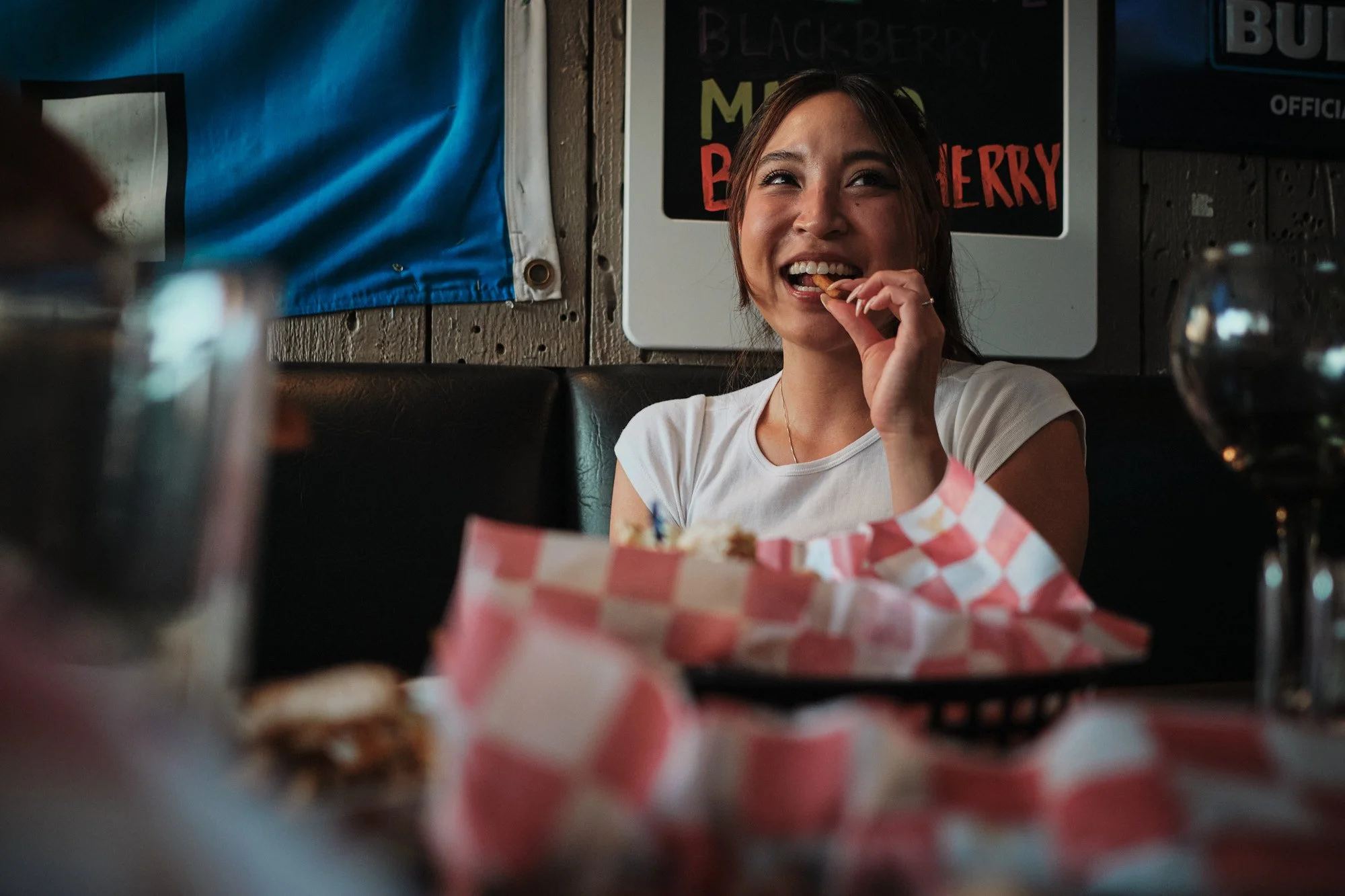
Check out Girl Noise Press, an independent publishing house founded by Diana Le.
Interviewer Katie Lee Ellison is a Seattle-based writer and teacher, and the founder of the literary event series Nonfiction for No Reason.
KK is a freelance photographer based in Seattle.
Visit Leny’s Place in Tangletown!