

DINING AND
WRITING
ALLY ANG INTERVIEWS SERENA CHOPRA AT BA BAR ABOUT HER FORTHCOMING THIRD BOOK, A CATALOG OF FUTURE MERCIES
WRITTEN BY ALLY ANG
PHOTOGRAPHY BY JAKE NELSON
The night before I met up with Serena Chopra at Ba Bar Capitol Hill to discuss her forthcoming third book, A Catalog of Future Mercies (Graywolf Press 2026), she invited me to a performance of “for posterity: proof of free will” at Town Hall Seattle, a show created and directed by skye hughes and starring Serena alongside Alyza DelPan-Monley, HATLO, Lío Sainz-Jones, and Fox Whitney. I didn’t know what to expect from Serena’s vague invitation, and when I entered the space to find low lighting, a rock placed deliberately on each chair, and two percussionists (Scott Farkas and Pau Michels) improvising a soundscape of chimes and small objects being dropped and brushed across various surfaces while eerie illegible whispers played in the background, I still didn’t know what to expect.
What followed was a “speculative oral history,” an entirely improvised panel conversation taking place long after humanity is extinct, during which a group of interstellar researchers (played by Serena and her fellow performers) looks back on our current moment and explores what happens when humanity stops clinging to capitalism or even survival, and instead focuses on dying with dignity and attempting reparations towards Earth and its inhabitants. As grim as the premise may sound, I was inspired by the vision of the future that the show presented: one in which humans experience a collective “psychic awakening” and finally recognize themselves as truly being of the world, not separate from it. One friend said to me during the post-show reception, “This made me feel like it might actually be worth sticking around through the end of the world.”
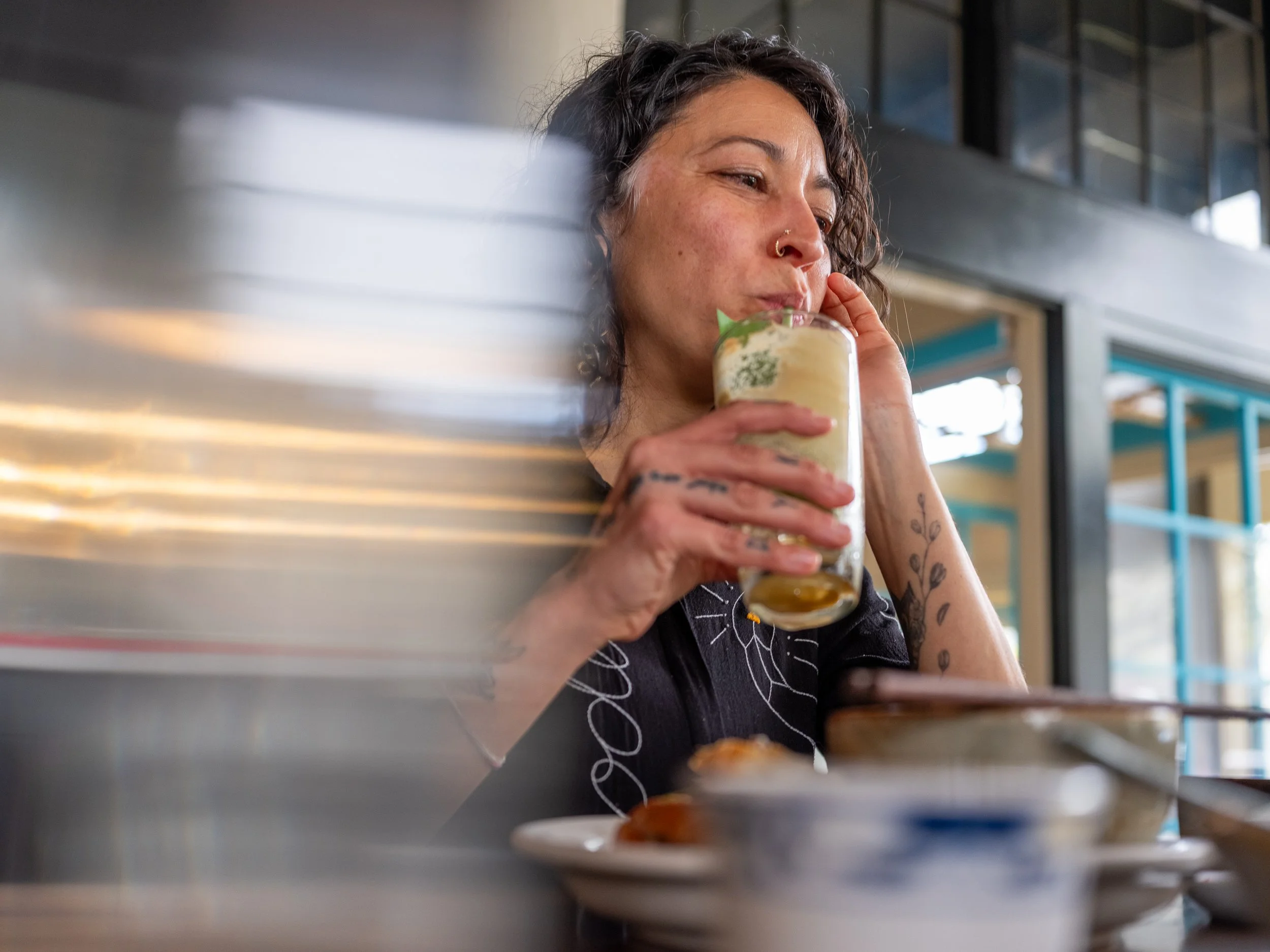
Like her work, Serena Chopra is someone who defies categorization and linearity, who looks beyond the limits of our current reality and imagines future possibilities. She is a teacher, writer, dancer, filmmaker, and a visual and performance artist, and the spirit of each of these disciplines courses through both the art she creates and the way she moves through the world. When I meet up with Serena at Ba Bar the next day and ask her how she thinks about interdisciplinarity over a vegetarian vermicelli bowl (for me), the “phở-rench dip panini” (for her), and pandan iced lattes (for both of us), it is clear that her commitment to hybridity and blending genres is more than a simple matter of aesthetics.
“Hybridity and interdisciplinarity [resist] the repetitive narrative plots that we consume mindlessly — beginning, middle, end. Socially, that narrative is super problematic. It tells us that if there’s a problem, there’s a way to overcome it. But when you’re dealing with things like racism, homophobia, violence against queer bodies, you don’t overcome it individually,” Serena shares amidst the backdrop of chatter animating the restaurant, decorated with verdant plants and a large Pride flag hanging near the open kitchen, where we can hear the sizzle of cooks preparing our meals. “So with a narrative like [A Catalog of Future Mercies], where no one overcame anything, there’s no resolution. We’re all still existing in proximity to our pain. Resilience is not about overcoming, or retraumatizing, but it’s about witnessing yourself and others and finding how to live.”
The book resists succinct description: a poetic memoir challenging the traditions of both genres.
Through poetry, photography, interviews with Serena’s family members, and speculative imagining, A Catalog of Future Mercies explores how violence and mercy reverberate through three generations: first with Serena’s grandmother Dayawati, who endured years of domestic violence, then examining her father’s role as both victim and perpetrator of abuse, and finally spanning into the present as Serena reclaims her narrative and erotic power. The book took a decade to complete, starting in 2015 when she began writing about old family photographs. Later that year, Serena traveled to India on a Fulbright fellowship and visited Bangalore, where her father had grown up, for the first time. On this trip, she was able to connect the family stories she’d always been told with physical sites, and she began piecing together a fuller picture of her family’s narrative. She started recording interviews with her father, stepmother, and sister — who organized and digitally archived nearly 80 years of family photographs for the project — and the book slowly began to take shape.
What Serena ultimately created from her process of research, excavation, and divinatory work is a book that resists succinct description: a poetic memoir that challenges traditional understandings of both genres, a family history that proves that the past (to paraphrase Faulkner) is never truly past.
At the heart of A Catalog of Future Mercies is Serena’s spiritual connection with her grandmother: As a young girl, Serena always felt a strong affinity and interest in Dayawati, whom her father often told stories about, despite having been a baby when she passed away. After her grandfather moved in with Serena and her parents when she was 11, she began to sense Dayawati’s presence in their home, often sitting at the foot of her grandfather’s bed. As Serena started to write this book many years later, she did more intentional divinatory work with Dayawati’s spirit, inviting her to share her story, one that had been denied to her in life by years of relentless abuse.
Strongly informed by Audre Lorde’s theory of the erotic as a source of power, A Catalog of Future Mercies embraces sensuality as a radical act of bodily reclamation for women, queer people, and survivors of violence. “That’s why there’s so much embodiment in the book,” Serena explains. “I had a sensation that [for Dayawati] there was a kind of displeasure, numbing, distance from the body. I felt that the book was an opportunity to give her a body that was articulate in terms of her story, but also sensual. That’s why the book is so sonically oriented, too: because she lost her hearing, I wanted to give her a story to hear for herself.”
Like her work, Serena Chopra is someone who defies categorization and linearity.
While we chat and enjoy our meals (the mushrooms in my vermicelli bowl are to die for), I feel myself repeatedly getting chills as Serena speaks about her relationship with Dayawati. For children of immigrants and particularly for mixed-race people like Serena and myself, our relationships with our histories, cultures, and ancestors are often fraught and haunted by gaps in knowledge — whether from trauma, displacement, or deliberate erasure. Serena’s divinatory poetics show me new possibilities for approaching the unanswerable questions about my own history that have followed me throughout my life, and for forging relationships with my ancestors who are no longer living.
Our conversation is a powerful reminder of what poetry can do: to reach across these gaps, to gesture towards an intuitive understanding that transcends knowledge. As Serena puts it, “‘Poetic’ is a way of being and not a genre… To me, teaching poetry is about sending people into the world who have a relationship to the poetic, which means they have a relationship to compassion and empathy and that they see others in themselves, themselves in others.”
This compassion and empathy is at the core of A Catalog of Future Mercies, which poses seemingly insurmountable questions: What does mercy mean in the context of generational violence? How can we continue to be in relationship with those who have harmed us without reproducing that harm or simply forgiving and forgetting?
“It is said that mercy is like forgiveness…” writes Serena in the poem “Ji: A Catalog of Future Mercies,” which is addressed to her father. “Amnesia sighs the debt of this resemblance. / I tug on the heart of difference. I plead.”
The book offers no easy answers, instead urging readers to examine the moments in which harm and love coincide, to honor the complexities of love and pain alongside one another. This, in Serena’s view, is the most powerful form of poetic practice.
Join author Serena Chopra for the launch of A Catalog of Future Mercies at Elliott Bay Book Company on Thursday, June 25; check out her book tour schedule; and/or attend an upcoming poetry reading featuring Serena Chopra on Saturday, June 6 at Open Books in Pioneer Square.
Interviewer Ally Ang is the author of Let the Moon Wobble (Alice James Books). Their work has appeared in The Rumpus, the Academy of American Poets’ Poem-a-Day, Seattle Met, and elsewhere. They co-host Other People's Poems, a poetry open mic and reading series in Seattle, which will feature Serena Chopra on Saturday, June 6.
Photographer Jake Nelson is a local freelance photographer and a teacher at Photographic Center Northwest. You can find Jake’s work on his website and Instagram.
Visit one of Ba Bar’s Seattle locations!