

DINING AND
WRITING
TAMIKO NIMURA JOINS JANE WONG AT CHEBOGZ TO DISCUSS HER MEMOIR AND REFLECTION ON JAPANESE AMERICAN INCARCERATION, A PLACE FOR WHAT WE LOSE
WRITTEN BY JANE WONG
PHOTOGRAPHY BY OLIVER VY LÊ NGUYỄN
When I arrive at CheBogz, a family-run Filipino restaurant in Beacon Hill, to meet fellow memoirist Tamiko Nimura and photographer Oliver Vy Lê Nguyễn, the first thing we do is exchange snacks. I bring Li Hing gummies from Hawai’i and Tamiko brings homemade salted chocolate brownies. All three of us have that unmistakable nod of kinship aka “let’s eat.” We open our conversation akin to the opening of Tamiko’s memoir, A Place for What We Lose – with sunlight and warmth.
I know Tamiko through the Asian American literary community and have been an admirer of her work for years. Based in Tacoma, she is an award-winning nonfiction writer, public historian, and dear friend. Indeed, she’s visited my Ethnic Studies classes at Western Washington University to share her work, which has appeared in national publications like The Rumpus and San Francisco Chronicle, as well as local outlets like The International Examiner. This is the first time that we’re sharing a meal together, but it feels like we’ve been passing around food for decades.
In A Place for What We Lose, Tamiko delves into the layers of her family’s incarceration at Tule Lake from 1942 to 1946. Over 125,000 Japanese Americans were incarcerated during World War II and Tule Lake, located in northeastern California, was one of the ten major incarceration camps. Prior to Executive Order 9066, Tamiko’s family lived on a ranch in rural California called Long Valley. Tamiko writes about how her family grew their own vegetables and foraged for bamboo shoots.
“I [hadn’t] read my dad’s book since I was a child. The only way out of grief is through, but it took me so long to figure that out.”
Tamiko didn’t write this book alone. She weaves in excerpts from her late father’s unpublished memoir into her book, singing forth the grief of suddenly losing her father at a young age, while also uncovering her family’s past by venturing herself to Tule Lake as an adult. A Place for What We Lose is written in vignettes that move through the form of a library, with sections like “Reference,” “Archives,” “Card Catalog,” and “Community Meeting Room.” In sharing about the form of the book, Tamiko tells me how she had numerous structures over the years that didn’t quite fit, until a friend of hers asked a key question: “How does the book want to be structured?” She knew and felt it then: “I feel that it wants to be a library.”
As Tamiko and I talk, we’re comforted by the familiar smells of soy sauce, garlic, shrimp paste, and vinegar. We’re surrounded by heaping plates of pork sisig, pancit, and garlic rice. CheBogz is bustling during lunch, with people sharing plates and gossip. It’s a small, cozy spot with lots of light and brightly colored plates and decor.
As we share more sisig and rice, Tamiko tells me how this book took fifteen years to write, how returning to her father’s memoir was such a powerful process of uncovering the past to understand the present and the future. “I [hadn’t] read my dad’s book since I was a child. The only way out of grief is through, but it took me so long to figure that out.” Her father, who was a librarian and writer, passed away unexpectedly when Tamiko was ten years old.
The grief Tamiko moves through is simultaneously personal and collective. In the chapter “Baby Pictures,” her father writes about having to burn baby pictures, as the U.S. government deemed them dangerous. He writes: “Taking a last look at each one before burning them, I felt that a part of me died with each picture that went up in flames.” Tamiko reflects later on this loss, with sadness and rage: “It’s the willful destruction of innocence that makes me sad—how could baby pictures be a threat to any kind of state or national security?”
“There is a memory I don’t want to tell but demands the telling.”
A Place for What We Lose insists on telling necessary stories for fear of them being lost, destroyed, or stolen. As such, the archive needs tending to. As we share about our similar, yet different experiences of familial hoarding, Tamiko tells me: “I have a scrapbook from my aunt with photos, newspaper clippings, cards, letters, Valentines, all these things. And I have tons of photo albums – an abundance of family archival material. So I was kind of like, how could I not do something with it?” In many ways, Tamiko’s memoir activates these luminous archival materials, some of which still exist – like her father’s manuscript – and some of which exist only in memory. In “Voices Together,” Tamiko recalls a cassette tape where her father and her grandmother teach her to say her name. “I don’t know where the cassette is now, but I play it mentally for myself over and over. It’s the only recording I know of with their voices.”
During those fifteen years of writing, activating both painful and tender memories required time and community connection. Tamiko tells me how co-writing in spaces and workshops like VONA (Voices of Our Nation), a virtual retreat for writers of color, allowed her to tap into deeper interiors of her memoir. She’s also a board member of the Tule Lake Committee, which educates the public about Japanese American incarceration during World War II, and organizes community pilgrimages to Tule Lake.
In particular, her own pilgrimage to Tule Lake was a significant experience, where multiple losses in her life coalesced together into a kind of grief chorus: “When I went on the community pilgrimage, I had this huge ugly cry, this upswelling of all kinds of grief. It was collective grief about the incarceration right where our family was. I was missing my dad and I was also feeling the loss of my [academic] career. And that I got to teach again there was such a big deal.” In the latter half of the book, Tamiko writes about facilitating a three-hour conversation at Tule Lake, creating space for collective healing and listening – including her own release of emotions: “[This was] a place where I could feel not just one of my losses but the whole interconnected web of them.”
There is a moment in her memoir where Tamiko says directly and vulnerably to the reader that she struggles with telling the memory of her father’s death: “There is a memory I don’t want to tell but demands the telling.” And how that grief was felt in the body, in that longing for his return: “None of us would sleep in the exact place where my dad had slept.” In understanding this grief chorus and its reverberations, Tamiko considers how parts of grief gave her purpose: “Camp grief for me simmers consistently as a level of anger. It’s a generative anger, though. And I’m not alone in this anger…” In “Kite Flying,” Tamiko writes about the painful symbolism of her dad’s memories of kite flying contests during incarceration: “What is it to create something made to fly, mark the wind paths, ride the wind – something for prisoners to create, a visible symbol of tension between ground and air, between being free and being grounded?”
With mass incarceration, mass deportation, and family separation happening right now, that anger and grief is ever-present. As is the necessity for community action, nourishment, and caretaking. As Oliver Vy takes photographs, Tamiko and I keep joking about making a mess. “That’s how you know it’s good though,” I laugh, glimmering in the specks of rice around us. Tamiko points us to a moment in her memoir where, on the bus during the community pilgrimage to Tule Lake, everyone starts sharing snacks. “We got snacks for each other. No matter what’s going to happen, knowing it’s going to be an emotional journey, we will be feeding each other, passing grapes.” Both Oliver Vy and I emphatically agree: “You have to have snacks!”
In reading A Place for What We Lose, I kept feeling portals of time open. And, as such, this is a book that doesn’t quite end. In “You Will Leave Here,” Tamiko writes a letter to her father, dreaming of going back in time, to find him at camp. She writes with loving insistence: “You will leave here. I will come back for you.” As we leave CheBogz, the sun is peeking out and Tamiko tells me about how she also wrote a letter to her book. “I am still learning from my book,” she says. I can’t help but hold that thought with me as a writer and reader, with the utmost gratitude. How can we be porous to all the teachings within a book and all that it touches?
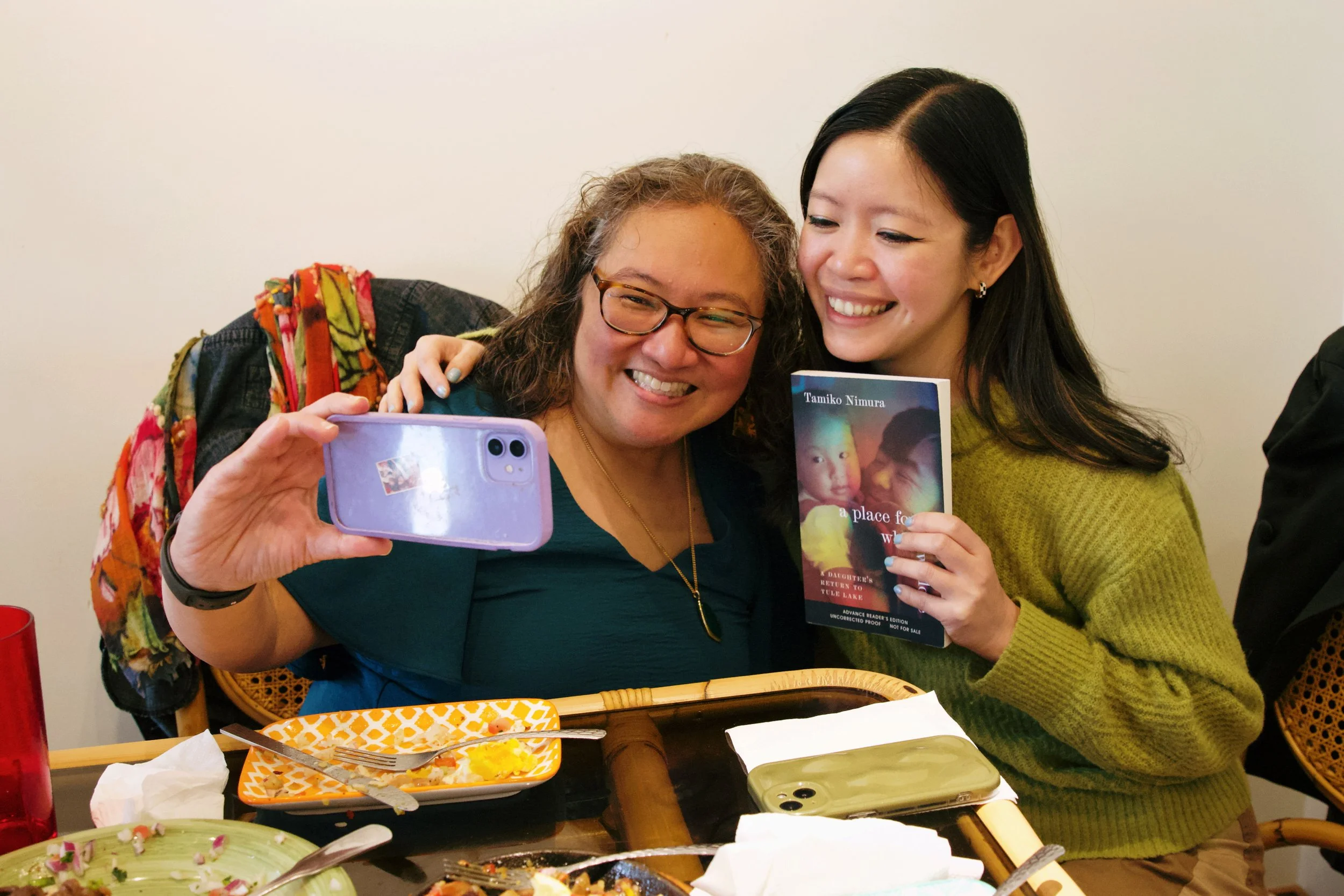
A Place for What We Lose is now available through the University of Washington Press.
Join author Tamiko Nimura for launch events in Tacoma on Tuesday, April 28; Olympia on Thursday, April 30; Seattle on Tuesday, May 5; and Portland on Tuesday, May 19.
Interviewer Jane Wong is the author of the debut memoir, Meet Me Tonight in Atlantic City, and is an Associate Professor of Creative Writing at Western Washington University. She is also the author of two books of poetry: How to Not Be Afraid of Everything from Alice James (2021) and Overpour from Action Books (2016).
Photographer Oliver Vy Lê Nguyễn is a queer and trans* Vietnamese documentary photographer and artist. Oliver Vy’s work explores themes of identity, belonging, and existence, and can be found on his professional website and Instagram.
Visit CheBogz in North Beacon Hill!