

EXTRA TIME
Through accessible spaces, free programming, and a global spotlight, the World Cup showed Seattle in its idealized form. What would it take to keep things going?
PHOTOGRAPHY AND WRITING BY BY GRACE MADIGAN
The end of the World Cup is upon us. Following a six-week barrage of soccer matches, including a half-dozen games here in Seattle, the city is now settling unceremoniously into its post-World Cup identity. The waterfront is once again crowded with more cruise-ship passengers than FIFA-focused visitors; Lumen Field is back to being called, um, Lumen Field; and Pioneer Square lacks the thousands-strong throng of fans it saw just a couple weeks ago.
FIFA announced two years ago that Seattle would host several World Cup games. Ever since then, I’ve wondered how our city would look and feel when the tournament arrived, and how our city would look and feel when the tournament left. As a youth soccer coach, a food-industry worker, a writer, and a die-hard sports fan, I’ve wondered whether the World Cup would successfully channel the city’s passion for soccer and do good for the city, and whether the energy and excitement surrounding the tournament could be a springboard for something more permanent beyond the “activations” popping up across the area.
Put differently: Was the World Cup going to be another come-and-go, lightning-in-the-bottle moment, or something with more staying power?
I tried to answer these questions by straddling the worlds of visitors and locals during the World Cup. Hanging out with tourists at public watch parties, and with some former kitchen colleagues at a Oaxacan restaurant. Watching a pro-Palestinian pop-up soccer game in Pioneer Square, but also learning how to drink from a shoe thanks to an Aussie in Fremont. Cheering on men’s teams performing on the world stage, as well as semi-pro soccer squads playing in Interbay.
What I found was a city proving that its idealized form is attainable: Accessible and walkable spaces, free and well-funded programming, open political expression (for the most part), and a hunger to come together. Visitors and locals expressed pleasant surprise at the city’s success when thrust into the spotlight; they wanted other places to emulate this idealized form, too. To keep that good energy going certainly depends on political priorities, but it also means recognizing and uplifting the unique soccer culture Seattle’s built over the course of decades: one that’s unapologetically welcoming and politically seasoned, and that approaches talent of all backgrounds and levels as a cause for celebration.
KICKOFF
Signs of the World Cup’s arrival started with the infrastructure. Public money poured into revamping the waterfront, wrapping up the ferry terminal renovation, and updating Westlake Park. Then came the advertisements. Billboards from companies unrelated to soccer started popping up around the stadium – “score big with blah, blah, blah” and “don’t let [fill in the blank] stop you from the big game.” Every bar around town suddenly became a “soccer bar,” hanging a FIFA ’26 sign in their windows. The mostly vacant Pacific Place Mall downtown turned into a “soccer experience,” where fans could watch games on a triple-decker screen and grab food from local vendors. Pioneer Square and Seattle Center became walkable viewing-party hubs. Heck, the Seattle Sounders and Reign teamed up to bring a floating barge to the waterfront for some very scenic viewing parties. (Only VIPs had onboard bathroom access.)
For me, the tournament began at La Cocina Oaxaqueña on Capitol Hill, where I watched Mexico kick off the tournament against South Africa. Restaurant staff poured tequila shots for everybody from a soccer ball-shaped bottle after each Mexico goal. Passersby stopped to check what everyone was so entranced by on the patio outside the restaurant. Others sporting Mexico jerseys walked by and gave a “Vamos Mexico” cheer.
Like most other soccer fans around the world, I snuck in glances at group-stage games during work hours, and when I was off the clock, I found my way to various venues showing the matches. That didn’t include Lumen — er — Seattle Field; tickets carried a hefty price tag, and game times were, for the most part, in the middle of the day, excluding those who couldn’t take time off from work. But that didn’t detract from fans enjoying the game in their own ways outside the stadium.
My venues of choice were the free viewing parties strung across the city. Seattle Center was one of those hubs, and I gathered there with Bosnian fans on the night before Bosnia took on Qatar in a match that could send them to the Round of 32. The Bosnian fans were there to celebrate. Not because they could make it out of the group stage for the very first time, but because it meant so much for their country to compete on the international level. Just over 30 years ago, the Bosnian genocide displaced hundreds of thousands of people from their home; as fans told me, being at the World Cup was a declaration they had survived.
“PRIDE” FOR SOMETHING ELSE
It’s hard to compare how much soccer means to a country like the US, where the sport means a lot to some people, versus other countries, where it seems to mean something to everyone.
That tendency, though, didn’t prevent national media from projecting meaning onto World Cup games happening locally. That was especially true for the official “Pride Match Day,” which coincided with Pride weekend and centered around a high-stakes group-round match between Iran and Egypt.
Headlines pitched the game as a showdown between two extremely homophobic countries. The lead-up to the game suggested that this would be a big event, and perhaps a clash between homophobes and queer advocates. It wasn’t.
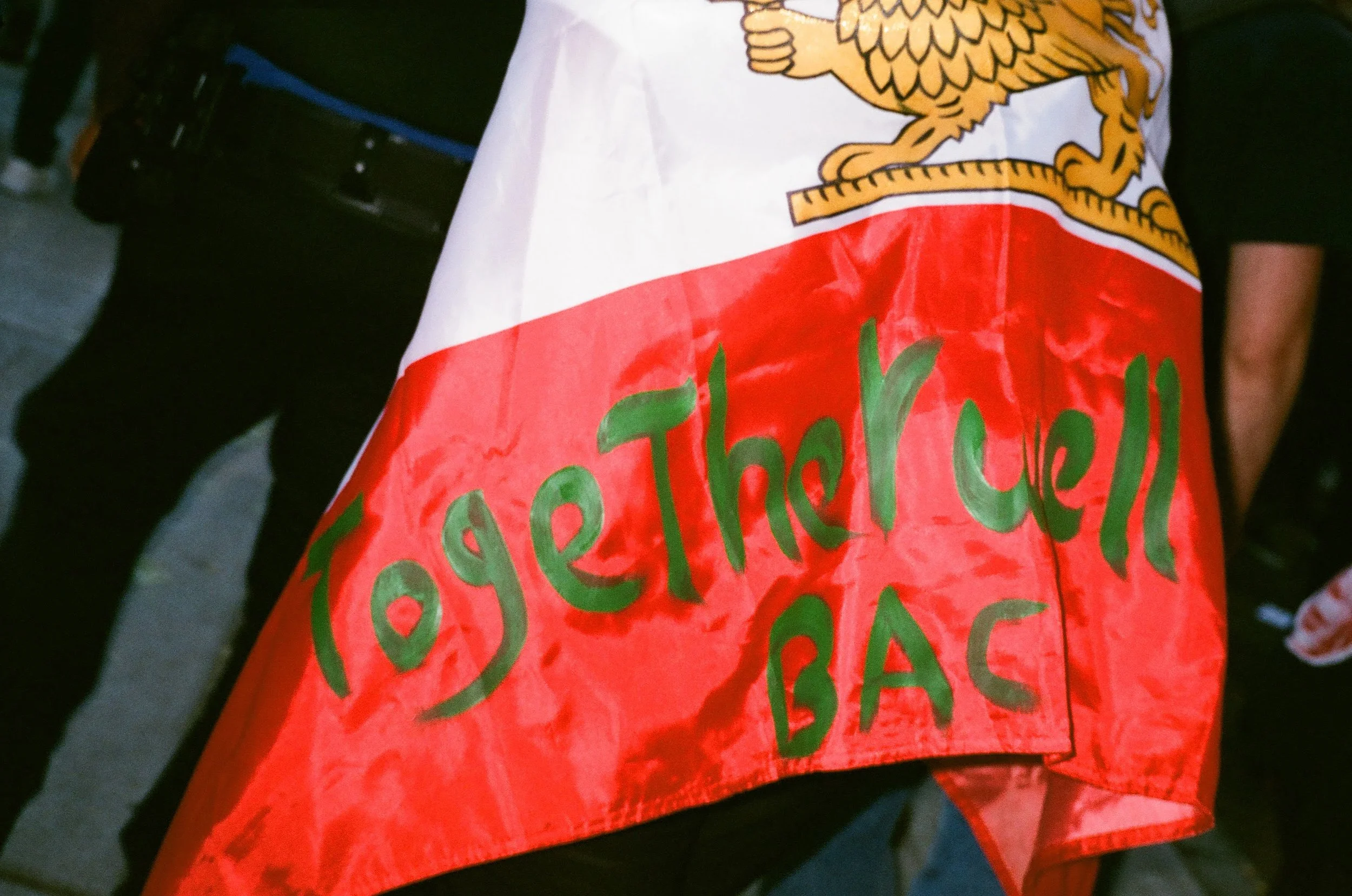
Walking around Pioneer Square ahead of kick-off, the most noticeable thing was the lack of rainbow flags. Instead, Iranian flags with the lion and sun – an emblem of Iran pre-Islamic Revolution – dominated. Before the tournament, FIFA banned this version of the flag, deeming it a political statement rather than a national one.
Imbuing politics with sports is not something new to Seattle fans. Among others, Seattle Sounders fans have always made their voices heard. A die-hard cadre displays an anti-fascist Iron Front flag during matches, and display signs reading “Chinga la Migra,” protesting ICE. Reign fans and the club have been vocal in their support for trans rights and Black communities, too. A few years ago the team’s jersey sponsor was the Black Futures Co-Op Fund, and they had the first openly trans player in their league.
There were plenty of fans with rainbow pins or flags — mostly white people — who came to the game. But from my perspective, the main issue that seemed much more relevant and urgent to the crowd centered around Palestinian liberation.
Before the match, people rallied nearby the stadium in support of Palestine and against FIFA’s decision not to ban Israel from the World Cup. Palestinian flags flew beside Iranian flags as a pop-up soccer match took place; demonstrators created an arena with their bodies in the car-free area on Occidental Avenue. For two countries whose own political conditions were tied up with Palestine’s, “Pride” themes were not the focus, but that didn’t mean the two couldn’t coincide.
As I wandered around speaking to folks as the game started, I noticed a man sitting outside a bar with the pre-1979 Iranian flag perched by his side along with a Pride flag. He wore a hat that said “Ghana” as well as a Seattle Sounders scarf. Not a sight I would expect for an older white guy in his 60s.
“We’re kind of celebrating the ‘alt-USA’ right now,” Jonathan Frodge told me. “The current regime does not represent who we are as a nation and who we are as a people. One of the tenets of the Islamic religion is that you welcome visitors to your land, so we’ve been welcoming Egyptians and Iranians.”
Frodge drew parallels between the current Islamic regime not representing the people of Iran as the current Trump presidency doesn’t reflect all Americans either.
So why were we projecting this image of Iran and Egypt as inherently homophobic onto its teams? For a country led by a man who’s successfully attacked trans rights, threatened to take away gay marriage, and wants to strip women of their reproductive rights — and presently bombing Iran, where LGBTQ+ people live, as they do everywhere — we’re hardly ones to talk. If the news wanted to see some big political statement, they didn’t need a World Cup, and they didn’t need to construct the premise of an “East versus West” conflict. Seattle soccer fans have always spoken up and will continue to do so long after the cameras are gone.
THE HOME GAMES
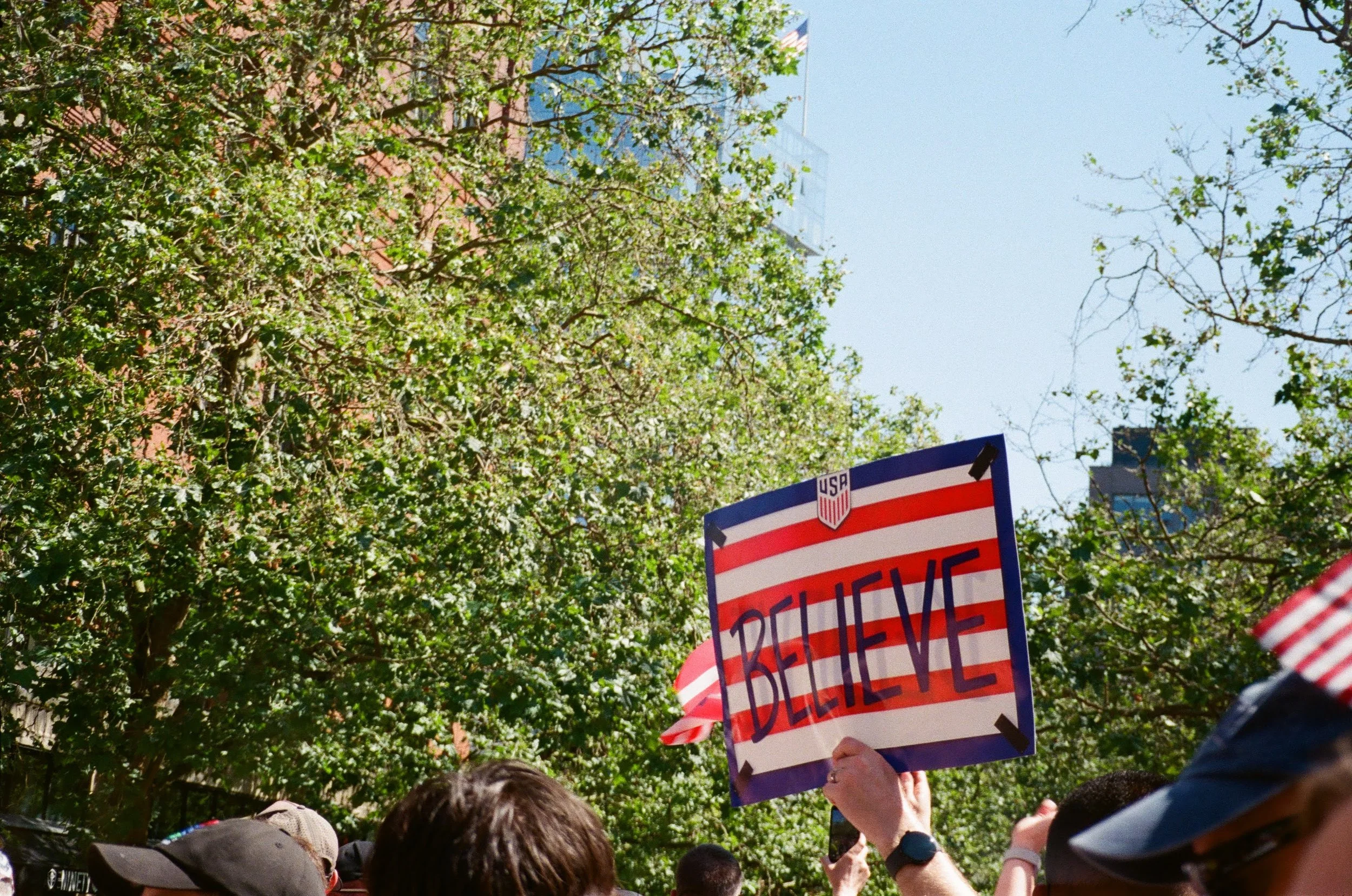
Despite the Trump-induced controversies that accompanied the US men’s national team, the energy in Seattle was remarkably high on days the home team played here. When the US returned to Seattle for its round-of-16 match against Belgium with a chance to advance to the quarterfinals — which hadn’t been done since 2002 — I was tasked with finding room at a bar for three others and myself in Pioneer Square.
I got to the area three hours before kickoff. But it wasn’t long before I realized how I underestimated just how caught up the city was in the tournament. It was match-day for the Sounders on steroids. Not only did you have every local soccer fan but people who traveled from across the country and around the world to attend this match. Every bar was packed. People swarmed the neighborhood, grabbing pre-match drinks and last-minute face paint.
Funwi stood in the middle of one of the car-free streets hawking gold chains with an American flag and tournament logo on it. He told me he’d been going to all the US games. He’s based in Los Angeles, and he'd already sold out of the jerseys he’d brought with him. All he had left to sell were the chains ($30). It was clearly a lucrative side hustle.
All eyes were on Seattle for the day. Broadcasters set up shots with a sea of red, white, and blue in the background. B-roll footage highlighted the city’s sweeping views. It felt like we were on stage for the world to see.
Robin Hordon knew that all eyes would be on the stadium and the surrounding area. He stood outside the line to get into the match wearing a hat that said: “Make America Native Again.” In one hand he held a poster reading “Play more sports, cancel all wars” and with the other hand he threw up a peace sign.
“I want to show the world that not all the United States of America are war mongers, in fact, the majority of us are standing for peace,” Hordon said. “I like to go to sporting events holding this sign because it would be a preferred way to solve disagreements.”
Some gave him a nod or threw up a peace sign themselves; most shuffled along as they waited to enter. The news cameras would never choose to point their lens his way, but it felt like a purposeful attempt to make use of this moment in the spotlight.
I then made my way to Elysian Fields next to the stadium. The line snaked out the door and was a block long. I staked out a spot next door at Sluggers, which has an upper level with a narrow walkway that looks down onto the bar area and faces a wall of TVs. Waitresses fanned themselves as the establishment continued to fill to the brim.
Maria, a back-of-house worker at the restaurant, took a moment to take in the spectacle. I asked to take her photo, which surprised her. I heard her speak Spanish, so I told her I’m sorry about Mexico’s disappointing loss. She shrugged and said, “They’ll try again in another four years.”
Sitting in Sluggers on the upper level, sweating profusely and awaiting the game to begin, bar classics blared over the speakers. And then it came on: the rallying anthem the US adopted for the tournament, John Denver’s “Take Me Home, Country Roads.”
The whole place burst into song:
Almost, Heaven, West Virginia/Blue Ridge Mountains, Shenandoah River…
Sure, we’re on the West Coast, thousands of miles from the region that inspired the ballad. But the sentiment still rang true. There’s nothing quite like coming home to the scenery you know so well.
THE OTHER HOME GAMES
Not every high-quality soccer game in Seattle will set you back thousands of dollars. Besides the Sounders and Reign, Seattle’s semi-pro teams are also a great time, and consist mostly of college kids or recent grads. Many of them play in the summer league to stay in game-shape for their fall seasons. These attended games have contributed to Seattle’s reputation for being a soccer-loving region; tickets are $20, and you can bring your own blanket to sit behind a goal.
The US men’s team is out of the running. But there’s still a home team to root for: On Saturday, Salmon Bay FC, the USL W women’s team based out of Interbay Stadium, will play for its first national championship.
Salmon Bay played its inaugural season just last year. Both Salmon Bay and its sibling team, Ballard FC, have tapped into Seattle’s grassroots soccer community: a passionate subculture that built the foundation for Seattle’s successful bid to host the World Cup.
I attended Salmon Bay’s semifinal game last weekend, when the team took on the undefeated Minnesota Aurora FC. Fans trickled in sporting Salmon Bay jerseys — plus the occasional Argentine kit, as their quarter-final game was going on just before kickoff at Interbay.
Sitting on the grassy hill behind one of the goals, I watched kids, ice cream in hand, cheer on Salmon Bay. To them, this game might as well have been the World Cup.
Teens enjoying summer break roamed around the stadium knowing in a few years they could be playing on that pitch. They know it’s not the World Cup, but the excitement of a big game that feels so physically and conceptually close to them gave it the same sort of thrill.
As the sun went down and the 90-minutes of regulation time ended, the two teams battled it out for another 30 minutes, which also resulted in a tie. Penalty kicks would decide who’d play for the championship the following week.
Fans raced to grab a view behind the goal, and became the 12th man when Minnesota players stepped up to take their PK, shouting in hopes of breaking their focus.
The night ended with Salmon Bay’s keeper making a couple of saves and Anna Menti, sister of Sally Menti who plays for the Reign, sending her penalty to the back of the net and her team to the final.
Players and staff stormed the field. The crowd went wild. High fives between strangers were exchanged. This energy was familiar. It was the joy that I’d seen downtown in Pioneer Square during World Cup games — only this time, the home favorite won.

If you’re feeling yourself missing the energy of the World Cup, you don’t have to look far for it. It’s at Interbay Stadium at Ballard FC and Salmon Bay games. It’s at Lumen Field for the Sounders and Reign. It’s across the city on weeknights after people get off work and play pick-up. It’s with the kids who eat orange slices at halftime and the high schoolers who play for state championships. The soccer bars that open up at 6 a.m. for fans to watch Premier League games.
FIFA has graced us with its (corrupt) presence and the gift of showing off to the world just how much of a soccer city we are. To the civil-society bigwigs and policymakers who shape this city’s built environment and disbursement of public funds: More of this energy is possible, but we need the spaces and price-accessible programming to get people together. Now, local soccer fans get to go back to what so many have done for so long: loving the game and supporting it wherever it appears. Hopefully, there are more of us now.
Grace (DD) Madigan is a queer, Chinese American adoptee and Seattle-based journalist. She contributes arts and feature stories. She was formerly the arts and culture reporter for KNKX radio, where she covered everything from Megan Rapinoe's last home game to a local cheesemonger competing in the national championship. She loves her cat Julie and coaching high school soccer in her free time.