

FROM THE COURT TO THE CONCERT HALL
As a local high-school prospect, J’Nai Bridges pivoted away from a promising future in basketball. Now, the three-time Grammy-winning opera star shares how athletics shaped her artistic success.
WRITTEN BY GRACE MADIGAN
PHOTOGRAPHY BY NATHAN ABIA LAWER- YOLAR
J’Nai Bridges is an athlete.
No, you can’t find any clips of her on SportsCenter’s Top Ten, and her name doesn’t appear on any WNBA roster. Yes, you’ll find her on the court at the Seattle Storm’s home opener on May 8, but she’ll be singing the national anthem, not shooting hoops. J’Nai Bridges’s typical arena is the concert hall: She’s a three-time Grammy-winning mezzo soprano who’s graced operatic stages around the world.
For all her globetrotting, Bridges says Lakewood, Washington, will always be home. The Tacoma suburb is where she grew up playing piano and singing in the church choir. She attended nearby Charles Wright Academy for high school, where her large and dynamic voice was discovered.
During returns to the area over the years for concerts and other productions, she’s been given a key to the city of Tacoma, and has been honored with a proclamation from the Lakewood City Council. Now, come Sunday, May 3, she turns to Seattle Opera for her full operatic debut, performing the titular role in Carmen, the iconic French opera.
Bridges is known today as the “Beyoncé of Opera.” But perhaps something like the “LeBron James of Opera” is more fitting: In an alternate world, instead of performing with Seattle Opera or singing at the Storm’s home opener on May 8, she might have been lacing up to take the court as a player. She was on that trajectory until her junior year of high school, when she chose to make the leap from the court to the concert hall.
Though Bridges talks openly and frequently about her transition from sports to singing, what remains underappreciated is how her grit and athletic talent — developed over countless hours on the court — have fueled her success in opera, too. Sitting on the bleachers of her old high-school gym, Bridges likened high notes to free throws, revealing a deft, elegant wrangling of opera’s sheer physicality; it’s a demanding art form requiring consistent excellence, and a hard-nosed determination to reach the highest levels of performance.
“That was the last day that I played competitively,” Bridges said. “I completely shifted my attention to singing.”
J’Nai Bridges’s love for music started at an early age. As a kid, she gravitated towards the piano and sang in the Tacoma Youth Chorus. But it always took a backseat to sports.
The beginning of Bridges' transition from basketball courts to concert stages started for pragmatic reasons. She had to fulfil her high school’s arts elective requirements, leading her to pick the choir.
During her junior year, Julie Kangas, Charles Wright Academy’s choir director, encouraged Bridges to start private voice lessons. She only began taking lessons in her final year in school — still set on pursuing basketball, yet curious about her newfound interest in singing.
In her final year at Charles Wright, Bridges planned on balancing both passions. She was cast in Tacoma Opera’s staging of the Italian opera Tosca, and she was also a captain for the varsity basketball team. Her coach agreed to let her pursue both as long as she could make it to practices and games.
This came to a head when Bridges raced from a rehearsal for Tosca to a district playoff game. Despite the agreement between coach and player, she was benched for not putting basketball first.
“That was the last day that I played competitively,” Bridges said. “I completely shifted my attention to singing.”
“When I first started singing, my teacher introduced me to the main aria [in Carmen,] ‘Habanera,’ and she was like, ‘I think you're gonna sing this one day.’”
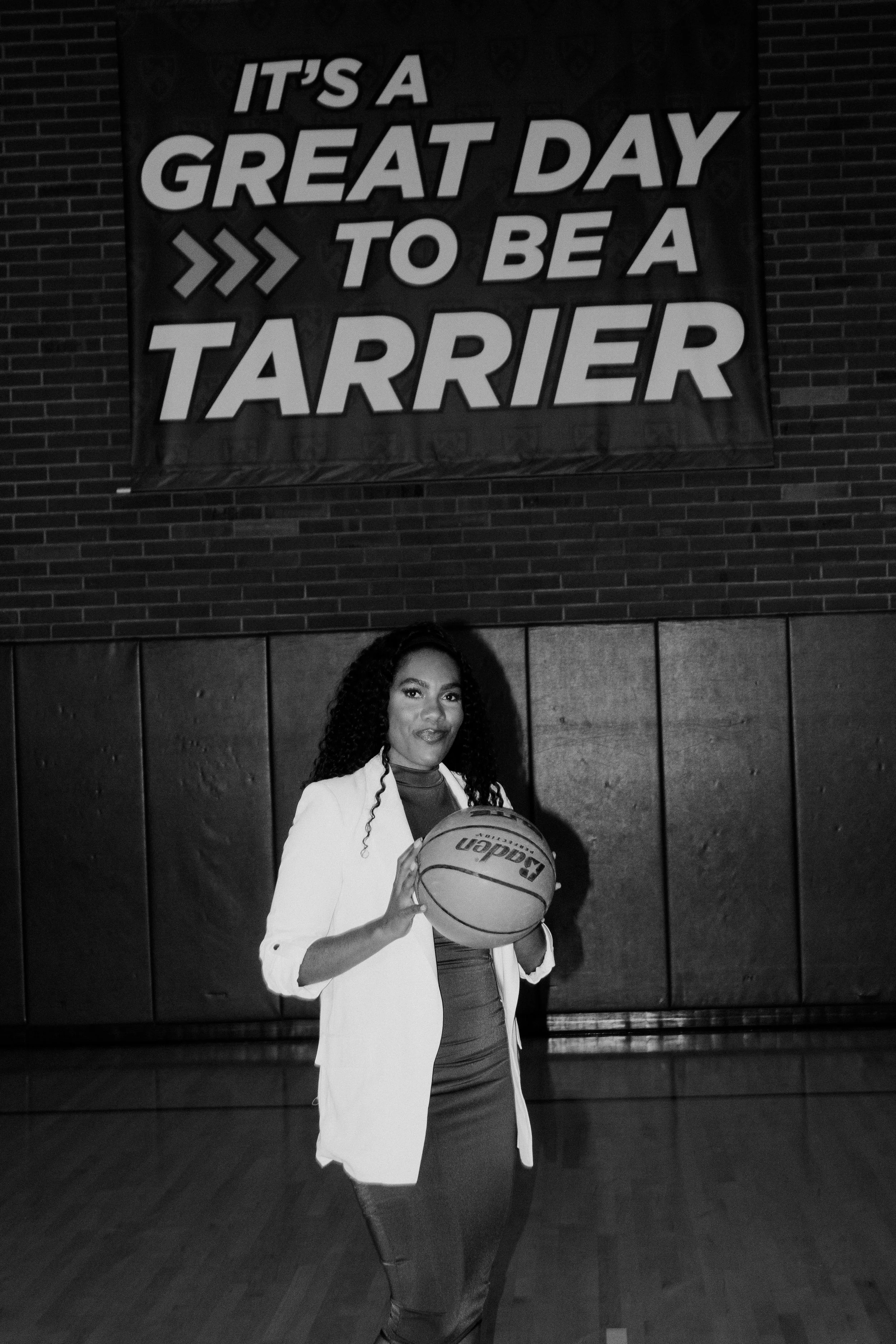
Bridges shared her journey as we sat on the bleachers of Charles Wright Academy’s main gym. In advance of her time in Seattle for Carmen, CHUM News requested a sit-down with Bridges to discuss how her athletic past has informed her artistic present; we also wondered which local basketball court might be most meaningful for a photoshoot and a chat. We met at Charles Wright, per Bridges’ suggestion. Before the interview and despite her formal attire, Bridges instinctively picked up a basketball and hit a few crossovers before taking a couple of shots. Her smile didn’t waver even after missing a shot or two. It was good to be back.
This is the gym in which she spent endless hours finessing her technique and conditioning her body for basketball. It’s this work ethic and attitude that she credits for making her as successful as she is.
“I envision — before I sing a high note — just nailing it,” Bridges said. “The actual mechanics that go into it are much like shooting a free throw. It's very technical. And so you practice in the practice room or on the court, very slowly and tediously, so that when you are on the stage or in the stadium, you don't have to think so much about technique: It just flows.”
Bridges compares the physicality involved in playing basketball with singing. One of the things that differentiates opera from other types of singing is that performers don’t use microphones, which means their voices have to be loud and robust.
“I have to hydrate, every day I sleep at least eight hours, I don't do dairy, I work out,” Bridges said.
The way Bridges talks about her singing and the work that goes into it mirrors the greatest athletes out there. There’s a refusal to accept what others might consider “okay” or “good,” even “great.” She wants to be the best.
“I'm taking voice lessons, I'm taking language lessons, getting coaching,” Bridges said. “That's all behind the scenes, and that doesn't stop just because I've reached a certain point in my career.”
Bridges’s first full debut at Seattle Opera as Carmen in Georges Bizet’s canonical opera, Carmen, comes this Sunday, May 3. She’ll take the stage for three additional performances on May 9, 13, and 17. She’s already deeply familiar with Carmen, having performed parts of it over the span of her career.
“When I first started singing, my teacher introduced me to the main aria [in Carmen,] ‘Habanera,’ and she was like, ‘I think you're gonna sing this one day,’” Bridges said.
The ‘Habanera’ is one of those songs you’ve most definitely heard, maybe in a commercial or movie, but may not know the name of. Carmen, which was originally set in Seville (Spain), and written in 1875, follows Carmen, a fiery, independent, and flirtatious local who seduces Don José, a local soldier. Jealousy leads to a tragic end for both characters. The character of Carmen was controversial when it debuted, but the character has since become a symbol of an empowered woman.
Bridges notes that opera is something a singer grows into. She didn’t perform the whole production of Carmen until 2014, while she was an emerging artist with the Lyric Opera of Chicago. In 2019, she made her professional debut as Carmen with the San Francisco Opera.
Later that year, she hit the milestone of making her Met Opera debut as Nefertiti in Philip Glass’s contemporary opera, Akhnaten. And the woman who started her down the path of classical singing, Mrs. Kangas, was there to watch.
“I was never the greatest student here at Charles Wright, but it was such an amazing school because they noticed the gifts of individual students,” Bridges said. “I knew that I was going to excel. I didn't know in what, because I thought I was going to go to school for basketball, do psychology, or something. But Mrs. Kangas heard that voice in me.”
From left: Melody Wilson (Mercédès), Meredith Wohlgemuth (Frasquita), Benjamin Taylor (Escamillo), and J'Nai Bridges (Carmen) in a staging rehearsal for "Carmen" at Seattle Opera. Photo: Sunny Martini.
By Bridges’s own estimate, she’s performed in 14 productions of Carmen. Seattle Opera’s version takes place in 1950s Havana, Cuba: a more modern take on the story. The contemporary adaptation is one of the things that excites Bridges about Seattle’s Carmen; by learning something new from each staging, her own role in the opera evolves.
“When I first approached the role [of Carmen], I was much more aggressive and physical,” she noted. “But now being more mature and having lived with the role, for me, Carmen doesn't have to do all this stuff to make people come to her; she just steps in a room, and people are like, ‘Who's that?”
“I just feel like I'm not acting anymore, I'm just her on stage,” she said.
Bridges probably won’t be singing Carmen forever. Unlike basketball stars, opera stars unlock new professional opportunities as they grow older and their voices change, meaning Bridges will one day move towards — in her words — the “many other roles to mature into.” Her love for basketball will “always be there,” she said, but it differs from her love for opera. “[With] opera, I see firsthand how my voice affects people, and it opens their minds,” she explained.
In a space that’s been dominated by people who don’t look like her, Bridges understands the impact and importance of being visible as a Black woman on stage singing opera. Following the murder of George Floyd in 2020, Bridges moderated a public conversation on racism and inequality in opera with the Los Angeles Opera, and she later performed in the world premiere of “America’s Requiem: A Knee on the Neck,” a commemoration to Floyd composed by Adolphus Hailstork.
The crux of art and opera’s power, in Bridges’s view, lies in its ability to affect people.
“You can either escape into a story, or you can have a really profound experience leaving the theater, asking, ‘Who am I? What is my position in this world?’ It can be entertainment, [and] it [can] also be therapeutic and healing,” she said.
“I just feel like my voice is literally changing the world,” she added. “I don't think I could have done that with basketball.”
Yet her journey to singing lead roles in operas around the world started on these hardwood gym floors at Charles Wright. With four upcoming performances as Carmen, showcasing her musical talents to Storm fans in between, Bridges is on the cusp of a month-long homecoming, at once an athlete and an artist. But make no mistake: J’Nai Bridges is proudly from Lakewood.
Grace (DD) Madigan is a queer, Chinese American adoptee and Seattle-based freelance journalist. She covers arts and culture in addition to anything soccer-related.
Nathan Abia Lawer-Yolaris a Ghanaian-born imagemaker, filmmaker, writer, and curator living and working in Seattle. He is a co-founder of Arrived Creative Collective, a non-profit dedicated to building exhibition space for Black and Brown artists across the country, and a co-founder of Kanea.tv, a creative production company.
See J’Nai Bridges at Seattle Opera on May 3, 9, 13, and 17; and at the Seattle Storm’s home opener on May 8.
This article was published on May 1, 2026.