

LAST WEEK, HIP-HOP LEGEND RICK ROSS PERFORMED AN AMBITIOUS, GREATEST-HITS CONCERT WITH THE SEATTLE SYMPHONY.
DID IT GO WELL?
ROZAY IN E-MINOR
WRITTEN BY ADAM WILLEMS
PHOTOGRAPHY BY MERON MENGHISTAB
WE NEVER THOUGHT we’d see people smoking weed in Benaroya Hall, home to the Seattle Symphony and its generally prim-and-proper repertoire, but here we were, in a throng of jumping fans, witnessing a 60-person orchestra performing alongside the rapper and mogul Rick Ross. Subwoofers thumped, violinists gesticulated, smoke wafted, phone cameras flashed, Rozay purred. Benaroya buzzed with a vibrant energy: home for the night to a Blacker, younger, hype-er crowd than usual.
The nine-time Grammy-nominated artist was in town last week for an unofficial first stop in his upcoming nationwide tour; he’s doing something of a victory lap to commemorate the 20-year anniversary of his debut album, Port of Miami. (“Hustlin’,” “Push It,” and other hit singles.) All the pieces were in place for a perfect melding of symphonic elegance with Rick Ross-y opulence.
As Rick Ross put it in an interview with CHUM News, he’s performing with orchestras as a way to “elevate it,” celebrate with longtime fans, and “bring the music to life” through live instrumentation.
“Every iconic artist at some point should [add orchestras] into the layout,” he said. “The possibilities are endless, and we should open that door. That's what fans of an artist that's been there for 20 years… deserve to see.”
Well, fans saw a good show, but they didn’t always hear a good show. Sound-mixing struggles, out-of-sync backtracks, and a sometimes sleepy showing by Ross himself made for a checkered delivery of his greatest hits. There wasn’t enough prep time to do the concert right: Ross and his cadre landed in Seattle a day later than anticipated, missing half of rehearsal and setting the performance up for unforced errors. Preventable mistakes that unfortunately added up.
By the time the show ended, the room lingered with awkward, PNW-y silence. The Seattle audience didn’t ask for an encore.
Rick Ross performs with the Seattle Symphony at Benaroya Hall (May 6, 2026). Photo: John Pendleton
If you’ve ever seen a YouTube video featuring the Seattle Symphony, there’s a high likelihood it’s from the orchestra’s most viral moment: its 2014 concert with Seattle hip-hop icon Sir Mix-A-Lot.
Doing some crowd work between songs, the rapper invites women in the audience to join him on stage; several dozen do, enthusiastically gyrating and singing along once he begins to perform “Baby Got Back.”
“I learned this from Ellen DeGeneres,” Sir Mix-A-Lot says as he takes a selfie with his on-stage dance troupe.
For many years, the Symphony’s prioritizing of rap-focused programming seemed confined to the 2010s — back when the DeGeneres selfie meme had a modicum of staying power. The frequency of hip-hop shows appeared to hit a small peak mid-decade, when the orchestra also played with Macklemore. Rapper Common’s tour came through Benaroya in 2023, and Macklemore came back for a benefit concert in 2024, but otherwise the lineup’s been sparse.
Andrew Joslyn hopes to change that. Previously Macklemore’s music director, among many other roles, he’s been organizing the Symphony’s popular programming for a little over a year, tasked with filling out Benaroya’s calendar with concerts that can bring in a wide range of audiences; there’s a “misconception” that symphonies are “for a rarefied few,” he says, and he wants to battle against that perception through exciting shows that get more people Symphony-curious. Inviting Rick Ross to Seattle was his doing.
“There’s such a strong audience in Seattle for hip-hop, and I wanted to give that audience a nice entrance into the classical arena,” he said. “This just seemed like a perfect show for that; it’s just this perfect gateway drug.”
Joslyn first caught wind of the Rick Ross opportunity after the rapper performed with an orchestra in Atlanta in 2024. Essence called that show an “unforgettable set”: a blend of “sophistication and grandeur” representing “a once-in-a-lifetime event for all who were fortunate enough to witness.” Hearing of its acclaim, Joslyn worked with Rozay’s agent and management to bring him to the West Coast.
But Rick Ross lives in Miami — about as far from the Pacific Northwest one can get within the continental US. By offering a package deal, in which the Oregon Symphony would also host the hip-hop mogul, Seattle landed a “yes.”
“Sometimes you have to sweeten the deal for the artists,” Joslyn said.
Speaking to CHUM News two weeks before the performance, Joslyn noted that a growing number of popular musicians are turning to symphonies as a way to make their music more dynamic, and their concerts more immersive. Artists like Rosalía and Raye have performed with orchestras on stage, and the trend seems to be catching on, he said. (We’ll add that Jeezy, the rapper, has also made a splash; his tour features a 101-person orchestra.)
Heartened by how quickly fans bought tickets to Rick Ross’s show, Joslyn said he hopes to add one concert like it to the Symphony’s yearly calendar. Joslyn kept his cards somewhat close to his chest, but he hinted at some of the performers he’d like to see at Benaroya in the coming seasons: 2 Chainz, The Dream, and (gasp!) 50 Cent, Rick Ross’s rival.
“Any symphonic performance with an artist is kind of the pinnacle of what you can actually really experience with an artist,” Joslyn said. “It’s their art — their vision — fully manifested, [showing] what can be possible when you have 60-plus musicians on stage backing them up.”
But the ways artists turn their vision into a real-life experience can differ dramatically. And they do so to varying degrees of success. Stated simply: How do you stay true to a song’s original melodies and ethos, while adding bassoons, piccolos, and timpani sets into the mix?
“Some arrangers will just needle drop it: They'll just take what's on the recording and just make it into an orchestra,” Joslyn said. “[Meanwhile,] some people really branch out and create new melody lines. They'll pretty much create a cinematic treat for the ears, but it’s still a hip-hop tune. There’s so much fun, artistic re-envisioning that you can do with these artists.”
What would Rozay do? We chatted with him ahead of the show to find out.
“Everything we said on record: Twenty years later, it’s what we live in. So why not walk in with that much more confidence?”
On occasion, Rick Ross talks the way someone who has synesthesia would. He approaches sounds as colors when making music, he claims. He wants his sounds to fill a space, enveloping the listener the same way smoke might surround you in a room.
“I want to be able to see the chords, the sounds,” he said in a 2021 podcast interview. “It just makes the words come that much easier.”
He spoke with us in similarly multisensory terms.
“When I’m thinking about a 60-person orchestra, I’m seeing the strings come alive,” he told CHUM News. “Imagine how expensive and rich that must feel for the boss, Ricky Rozay… It’s something that’s never been captured in that way before. It’s something that I haven’t done before. It’s not something that you see on a daily basis.”
Ross took the interview over Zoom from his home in Miami. It was late April, less than two weeks before his concert with the Symphony, and we came prepared with questions. If he really was a synesthete (many artists claim to be), what kinds of chords, sounds, and colors would Rick Ross create in unison with the Symphony? Why go through the extra effort to embark on an orchestral tour? And what might his music-making process look like on the other side of it all?
The artist appeared sincerely wistful at certain points in our conversation. He first performed “Hustlin’,” his debut hit single, as an opener for Trina; he still remembers how the audience connected to his first verse, helping him realize he was on the cusp of his big break. Talking to CHUM 20 years later, Rozay said his past self couldn’t have imagined his present-day success.
“I sat there in a dark room with the beat on loop when I wrote [“Hustlin’”] as a young artist,” he said. “Now, we have a mother fuckin' symphony with us! We got all our diamonds on. We've watched for the last 20 years everything come to fruition. Everything we said on record: Twenty years later, it’s what we live in. So why not walk in with even that much more confidence?”
The Symphony offers “total opulence,” he noted, adding that he possesses the skills and finesse to make good, dialed-in music.
“I understand the value of acute sounds, accurate precision,” Ross said. “I'm not just sitting in the studio with the bass on 10. [Mimics subwoofer sounds.] No, no, no, no. Turn that shit down to 2.8. I want to hear the clarity. I want the clarity to come through. If it was your grandmother riding in a Volvo 380 diesel, I want her to be able to be comfortable with the weight of the music.”
Driving the conversation forward, and approaching Seattle’s concert as a prelude to his longer string of concerts across the country, we asked Ross whether there was anything he hoped to iron out in Seattle before his nationwide tour commenced.
“I mean, you never know what can change when you perform live,” he said. “That’s always a good thing, because you only make changes for the better. But I’m pretty ready to come and set the new standard. I have no problem with that. I’m ready. The orchestra is ready. And we finna make a movie.”

When we showed up to rehearsal, which started at 1pm the day of the concert, our movie’s main actor was just getting off his private jet. He was meant to land the night before (ritzy lodgings had been reserved on his behalf) but he only took off from Florida in the late morning. His Instagram stories suggest he was tending to his armada of expensive cars, which includes a customized Tesla Cybertruck, and explaining to his followers why women who date him shouldn’t prioritize their careers. These two activities may be related.
The Symphony’s musicians, working between specific hours set by their collective bargaining agreement, weren't going to wait for Rozay. Stuart Chafetz, a veteran conductor of pop-music arrangements, took the time to walk the 60-person orchestra through some of the tracks. Chafetz was upbeat and carried himself a Symphony-friendly gentillesse. At one point, he invited his colleagues to turn to the sheet music for “‘Eff’ with me, you know I got it,” his PG stand-in for the real name of the song: “FuckWithMeYouKnowIGotIt,” a track featuring Rozay from Jay-Z’s 2013 album, Magna Carta, Holy Grail.
The arrangements didn’t sound technically difficult; the larger challenge was to imbue their rendition with the right energy and verve. By the looks of the audio engineer’s excited dancing, the symphony was hitting the right wavelengths, even in Rick Ross’s absence. We thought so too: The strings were equal parts measured and all-in, the brass section blared at the right moments, and the drums anchored it all, reminding listeners of the original tracks. The pieces belonged to the “needle-drop” variety of symphonic adaptation — not straying too far from the original melodies and structure — but they still added a remarkable, new texture to decades-old songs.
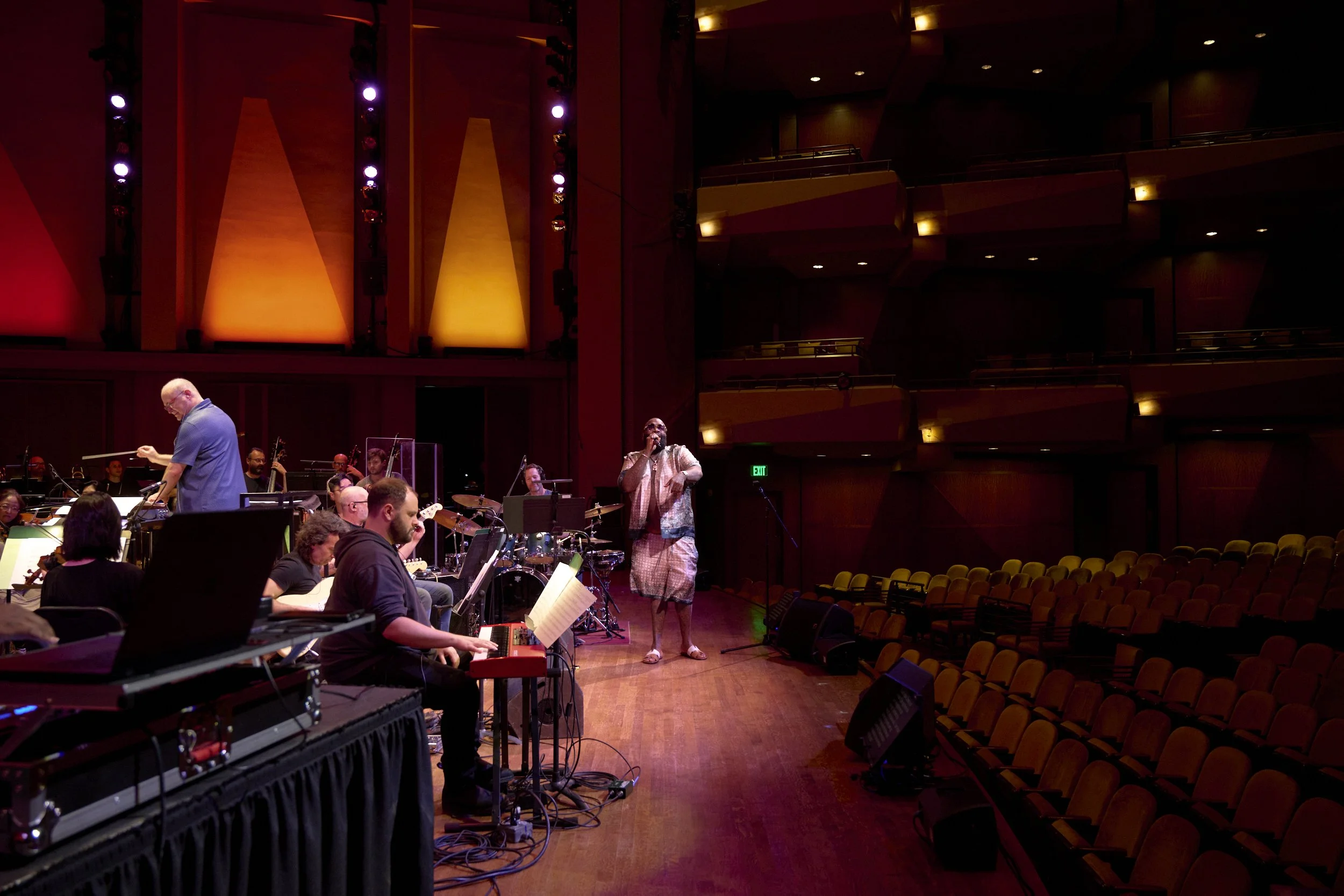
Rick Ross showed up just before the musicians’ 20-minute break, accompanied by a phalanx of security and other assistants. (Wearing an unbuttoned silk shirt, matching shorts, and slides, he looked like he had woken up in Miami and then traveled cross-country on his private jet, which in fact he had.) The tour DJ responsible for queuing up backtracks and background beats, DJ Nasty, beelined for his turntable setup, and began coordinating with the Symphony team handling audio. Rick Ross grabbed a microphone at one point to do a sound check, offering a trademark “huh” grunt into the mic.
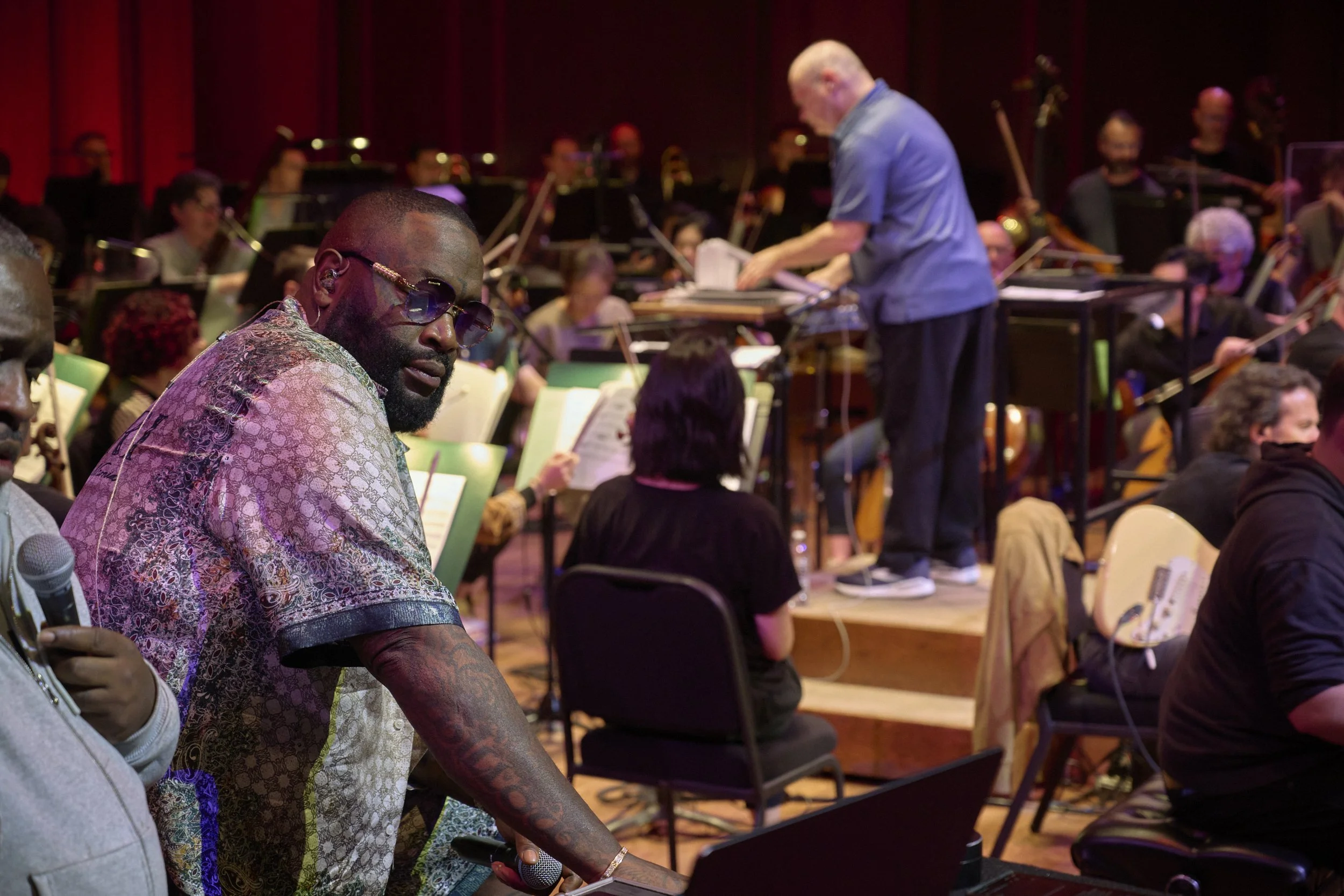
Once the musicians returned from their recess, the conductor whisked the Symphony and its headliner through their setlist. Rick Ross appeared ecstatic about the pieces that gelled well. Classical instruments, synths, and the rapper’s timbre swirled to make the multisensory, all-encompassing musical experience that Rozay had marketed. Seemingly taking a pre-victory lap victory lap, he began to amble around the stage, filming an Instagram story of the rehearsal.
Not shared with Instagram viewers was the unsexy chunk of time dedicated to troubleshooting audio and tech quirks. (Necessary grunt work that’s part of most rehearsals.) Some tracks could only be controlled from the hall’s tech booth, others from DJ Nasty’s computer, and not all of them patched in correctly to key musicians’ earphones. When those buggy audio files played, the drummer tended to perform slightly behind the music playing from the speakers, making for a clearly unintentional syncopation. The professional, capable production team moved as swiftly as they could to iron out the issues; but Ross and his entourage left before the rehearsal’s end time, meaning Benaroya’s technicians could only tweak so much. It left us wondering how the show would shake out.
Ross appeared to forget chunks of his lyrics, hovering conspicuously around a teleprompter to deliver his lines in a meek monotone.
Four hours later, looking at the stage from row Y, we saw the “total opulence” Rick Ross envisioned starting to come to fruition. The crowd was dressed sharply; walking out on stage to rapturous cheers, the rapper showed he was dressed to the nines too. His concert started on a high note, with some pandering about the Seahawks’ Superbowl victory followed by the timeless anthem, “All I Do Is Win (Remix)” by DJ Khaled (which features Ross). Between songs, Rozay did some cheeky crowd work, chatting frequently with an older woman at the front of the crowd. When the music played, a spectator a few rows ahead of us took his phone out to record the concert, swaying so enthusiastically that his video probably looked like it had been through a spin cycle. Sounds, colors, and smoke were all coming together, the way Rozay had foretold.
The illusion started to unravel bit by bit. We realized, upon hearing the organ-laden intro to Rick Ross’s 2010 ballad “Tears of Joy,” that Benaroya Hall’s pipe organ wasn’t being used; in our view, an opportunity to “elevate it” that sadly wasn’t taken. We understood the decision, though, as an organ might have drowned out the Symphony, along with Rozay’s rapping.
But then we realized we couldn’t hear the Symphony at all. The sound was being mixed the way Rick Ross supposedly despised: The bass and digital tracks were turned up to 10, giving the show the appearance of a partially silent movie (the aesthetics of a symphony, not its supposed synesthetics), backed up by Ross’s mezzo-forte vocals. Not great for a grandma’s Volvo 360 diesel, let alone any venue.
The sound mixing improved somewhat after the intermission. Though by that time Rozay seemed to be running out of steam. Performing his verse on Kanye West’s 2010 “Devil In A New Dress,” Ross jumped the gun on the intro, and appeared to forget chunks of his lyrics, hovering conspicuously around a teleprompter to deliver his lines in a meek monotone. He finished the verse a solid 10 seconds before his backtrack got to the end, awkwardly rounding out a poorly executed verse.
By the time DJ Nasty started to tee up Rick Ross’s latest track, “Minks in Miami,” the audience had started to thin out. (Car-bound Seattleites love to leave before the end of a concert to beat garage traffic; we hate this ritual!) But with the Symphony’s conductor and musicians sitting expectantly while Rozay rapped to his newest single, which lacked an orchestral arrangement, the musically elevated part of the show felt largely done. Rick Ross walked offstage soon thereafter, perhaps expecting an encore chant. A bold assumption to make about Seattle crowds, which sometimes struggle to clap on beat, let alone bring any end-of-show enthusiasm. But after starting at a high, and ending with a fizzle, the crowd wasn’t all too keen to prolong the concert’s dénouement.
What to make of the show post mortem? Debriefing the next day, we counted the pros and the cons of the concert, and noticed how most of the flukes were easily preventable. A full rehearsal would’ve largely done the trick; and a restful overnight stay in Seattle before the show might have kicked Rozay’s energy up a notch.
Even for spectators who felt the performance was a wash (we won’t judge them), we imagine they, like us, felt buoyed by the crowd. By Benaroya standards, younger locals — read: people in their thirties and forties — reconnecting with the rap they listened to growing up. People had cool clothes on. Brandon Roy was there. Black arts organization ARTE NOIR put together an eye-catching exhibition featuring Cheyenne Cauzabon, Myron Curry, Vincent Keele, Rubin Quarcoopome, and Jacqueline Smith. Weed smoke swirled, and nobody made a big deal of it.
“You only make changes for the better,” Rick Ross told us 10 days before the show; hopefully, he’ll take his own words to heart and easily tighten things up. For Symphony leadership, meanwhile, the lessons to be learned are in the crowd. Seattleites are eager for more concerts like this. Just better executed ones.