

SUITLESS IN SEATTLE
A COMING OUT STORY
WRITTEN BY AUDREY WANG GOSSELIN
PHOTOGRAPHY BY PAUL WANG GOSSELIN
I don’t imagine a lot of other young women dream about looking like a 60-year-old Swiss man, but if there are any of you out there, know you’re not alone.
You also might not be a woman.
When I joined the workforce in 2019, I had an issue that plagues many college graduates: I needed to buy clothes appropriate for the corporate workplace. So, I went to the JCPenney in Raleigh, North Carolina and purchased a polyester dusty rose blouse with frilly sleeves and blue-and-white pinstripe capri pants that I wore with royal-blue ballet flats. This felt like something a woman would wear to an office.
I remember sitting in my cubicle browsing the company’s internal news site when I saw him: the chairman of the board. An old, white Swiss man with his white shirt buttoned down just low enough that you could see his chest hair and gold chain popping out.
I wanted to be him.
Slowly my wardrobe started to change. Button-down shirts. Wire-rimmed glasses. Loafers instead of ballet flats. An oversized houndstooth jacket from the thrift store. And the crème de la crème: a Swiss watch my husband gifted me for Christmas.
Every now and then, I’d linger outside the Jos. A. Bank, watching the salesmen buzz around grooms preparing for their weddings, wondering if I might be able to go in. But I never had the courage to open the door.
In June 2023, I started to realize that it wasn’t just about work clothes. Something more significant was shifting within me. That summer, I gave a talk on corporate sustainability and greenwashing at the Lesbians Who Tech Pride Summit, a virtual conference primarily for queer women and LGBTQ+ folks. You’d think that a space like that would be the perfect Safe Space™, but in those (virtual) rooms, internal panic would set in whenever people asked me how I identified and what my pronouns were. I had a suspicion that there was something going on with my gender, but I couldn’t articulate it.
– Are you cis or trans?
– I don’t know! Can I be both? Or neither?
I used to love femininity. I once relished the chance to buy a new dress for every special occasion. My red lipstick and Chanel N°5 perfume, which once made me feel powerful, no longer felt like me. It felt like a costume.
So I called my sister to have coffee with me to talk it out.
We met in Cal Anderson Park. I grew up with a brother, but now I have a sister in whom I confide. She reminds me of Ursula from Kiki’s Delivery Service with her grounded nature and huge laugh. On that day, I remember watching her glide across the crosswalk at Broadway and E Denny Way, sun-soaked in a long, black summer dress and big floppy hat. The picture of warmth and tranquility.
I told her everything I was feeling. I cried. She cried.
“There can’t be two of us. We can’t both be trans. One of us has to be normal!” I exclaimed in a joking tone, but my laughter couldn’t hide the truth and desperation at my core. What are the odds that two siblings could both be transgender?
My sister chuckled and then asked me, “Imagine yourself at 80 years old. Do you see a little old man or a little old woman? I know I see myself as a little old lady with cats.”
The first image to splash into my mind was Yukio Akamine, a Japanese tailor and style icon I’d learned about through the Die, Workwear! blog. I recalled a photo of him skipping stones in khaki pants, white sneakers, and a white button-down shirt with the sleeves cuffed. I wanted to be like him when I grew up.
I know, I know. In the era of tradwives and the rise of conservatism, menswear hardly feels like a pathway to liberation. Even Pantone’s color of the year is white. But to equate classic tailoring with conservatism is to gloss over history, and is “reductive,” according to menswear writer Derek Guy, of Die, Workwear!
“Classic American tailoring is often framed in terms of whiteness (specifically that upwardly mobile class of White Anglo Saxon Protestants whose fortunes rose with industrial capitalism),” Guy told me over email. “But they simply wore the clothes; they did not make them.”
Guy outlined a rich, decades-long history of rebellion and self-determination expressed and extended through clothes. Young Black jazz musicians in the 1940s, for instance, pushed back against the norms of big band swing music by developing the bebop style of jazz, and grew to wear the formal garb they saw at the nightclubs and college campuses at which they performed. “Over time, many of these younger musicians adopted the look and made it their own, such as Miles Davis and Chet Baker buying their clothes from The Andover Shop in Harvard Square,” Guy told me.
The 2025 Met Gala “touched on some of this complex history” by focusing on Black dandies and the larger history of minority groups repurposing “hegemonic culture” to make it their own, he continued. And recent scholarship suggests “men across time and place” have used clothes to “tell their own narrative,” pushing back against the way others might see them due to their socioeconomic backgrounds.
“These histories show that classic tailoring is much more complex than the idea that it is ‘exclusive,’ ‘rich,’ and ‘white’ might suggest,” Guy said.
When Yukio Akamine wears a tailored suit whose colors reflect the seasons and that has been mended and cared for through the years, he’s conveying a respect for nature and artisans, and his philosophy that we should not overly emphasize efficiency or trends.
As Akamine splashed in my mind, I wondered what a suit might do and convey for myself: A form of self-discovery and self-expression, and an opportunity to subvert others’ expectations. Especially in corporate environments, where some assume that a (relatively) young, feminine, queer, multi-ethnic person such as myself is not to be taken seriously, a suit could potentially push back at observers’ reductive perceptions and assumptions.
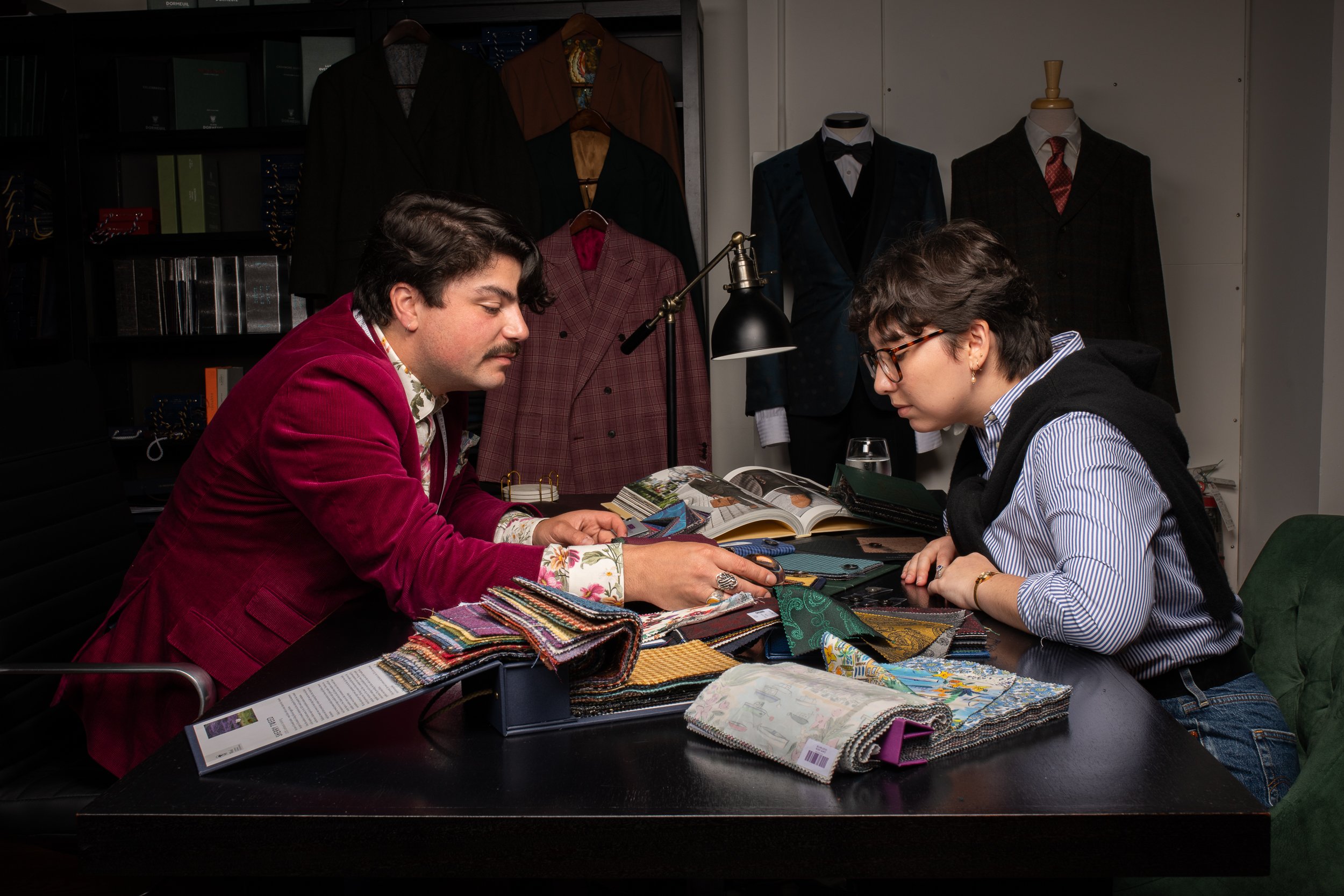
I’m critical and incisive, though not without reason. I needed partners in the creative process: true experts in tailoring and design.
The same summer I debriefed with my sister about gender, I also happened to get a new job with a lovely pay bump, and I decided it was finally time for me to get a suit to wear to conferences and company meetings.
However, I still wasn’t confident about going to a Men’s Warehouse or Indochino. People assured me, “They do women’s suits all the time!” but I wasn’t exactly looking for women's suits, and I didn’t want to look like a little man. I needed a tailor who could capture the fine line between masculine and feminine, and who would possess the emotional acuity to take care of my nervous, fluttering heart as I jumped out of the nest.
And here’s the other thing about me: I’m not just genderqueer. I’m also a snobby bitch. I’ve been snobby since I was a child. A schoolyard bully once called me Miss Priss. I’m critical and incisive, though not without reason. I needed partners in the creative process: true experts in tailoring and design, people who really knew the history and language of suiting and who saw it as an intellectual and artistic pursuit.
I saw Sew Generously Bespoke was the obvious choice.
I knew of Sew Generously Bespoke long before I ever reached out to them. I stalked their website and their social media pages for years. For my consultation, I wanted to impress. I wanted them to understand the caliber of client with whom they were dealing. I wore high-waisted, reverse-pleated black pants, a white button-down shirt from Ralph Lauren, and my favorite French, chunky-soled black leather loafers with gold hardware. Hung on my shoulder was my staple black Prada Saffiano leather bag, and clutched closely to my chest was my copy of Akamine Yukio No Kurashikku, a photobook capturing Yukio Akamine’s style and life philosophy.
I booked with Aidan, an artist and gallery curator by trade who — I hope he doesn’t mind my saying — looks pretty queer from his bio on the website. Serendipitously, his assistant that day was Jamie, a trans designer and recent graduate from the Parsons School of Design. (“I knew I liked you as soon as I saw that bag,” they later told me.)
I was instantly at ease in their care. For hours, we pored over the photos from my book and parsed through piles of fabric swatches and button samples. Ultimately, I had two suits made that combined masculine and feminine suiting elements to evoke my particular brand of genderqueerness:
Initially, I thought I wanted an oversized jacket, but trying on larger samples made me feel like I was trying to hide my body: The insecurity and body dysmorphia were visible. To create a masculine effect without looking like I was being swallowed in a man’s suit, we made the jacket a little wider through the chest than a woman’s jacket, but there is still a slight curvature to the waist to keep it elegant and flatter my silhouette.
The length of the jacket is longer than is usual, because I love the swooshing effect when I push the tail back to put my hands in my pockets. The suit was designed for my favorite movements and postures.
The shoulders are larger and more angular than you would typically see on a woman’s suit to give it a broader feel.
The notched lapels are also unusually wide just to add a touch of drama. (gay)
I chose high-waisted, reverse-pleated, wide-legged pants that fall straight to the floor, thus highlighting my waist without accentuating my hips.
The cuffs of my sleeves can be buttoned normally, but also have the flexibility to be secured as French cuffs. I do not yet own cufflinks, but I am hopeful that I’ll be gifted them one day, perhaps for a job promotion, a classic dad gift. (Dropping hints here to my husband.)
Then, there are the tiny details you’d only see if you were physically close to me — what Aidan calls “the reward for proximity”:
My two suits look like solid colors from afar: one green and one black. It is not until you’re up close and see the fabrics dance in the light that you might notice the green suit is actually striped, and the black suit is covered in flowers.
The black suit is lined with little bouquets, and the green suit is lined with tropical plants. (gay)
The buttons on my shirt are made from jade, a nod to my Chinese heritage.
The buttons on my black suit are actually red horn, which you can see in the right lighting.
My initials “awg” are stitched over the inside breast pocket.
What happens when I put the suit on? I’m communicating:
I’m a feminist (yay, pants!) and find beauty in the genderqueer.
I value the work of artisans and artists, and I believe everyone involved in the making of my garments — from the field to the textile mills to the suit shop — deserves a living wage and a livable future.
Like the people of color and queer people who came before me and fought for our civil rights while impeccably dressed, I reject the rules and norms imposed on me by others.
Unfortunately, suits can only do so much of the talking. A very well-meaning straight coworker saw me in my black suit with slicked-backed hair, heavy silver chains, and a dagger earring (so queer-coded it hurts), and she attempted a compliment by cooing, “Oooo! Lady in black!!” Swing and a miss.
The present-day threat of bathroom bills, anti-drag bills, and anti-trans sports bills all serve one idea: that trans people should not exist in the public eye (and ultimately, should not exist at all). It has crossed my mind as I wear these suits in a women’s bathroom: “Is someone going to throw a fit?” But I don’t want to hide, to chameleon myself into the current bland political pantone for safety’s sake. Menswear is, oxymoronically, for everyone.
I know how I feel about myself, and I know that I come to life when I wear these suits. I know 17-year-old Drey, who wanted to cut their hair short with a little blonde streak in the bangs like One Direction member Zayn Malik, would be in awe if they saw me now.
Audrey Wang Gosselin (they/them) is an organizer and content creator in the climate and sustainability space. They write creative non-fiction focusing on gender, feminism, and LGBTQ+ issues.
Paul Wang Gosselin (he/him) is a Seattle-based photographer interested in providing product and portrait photography for local small businesses.