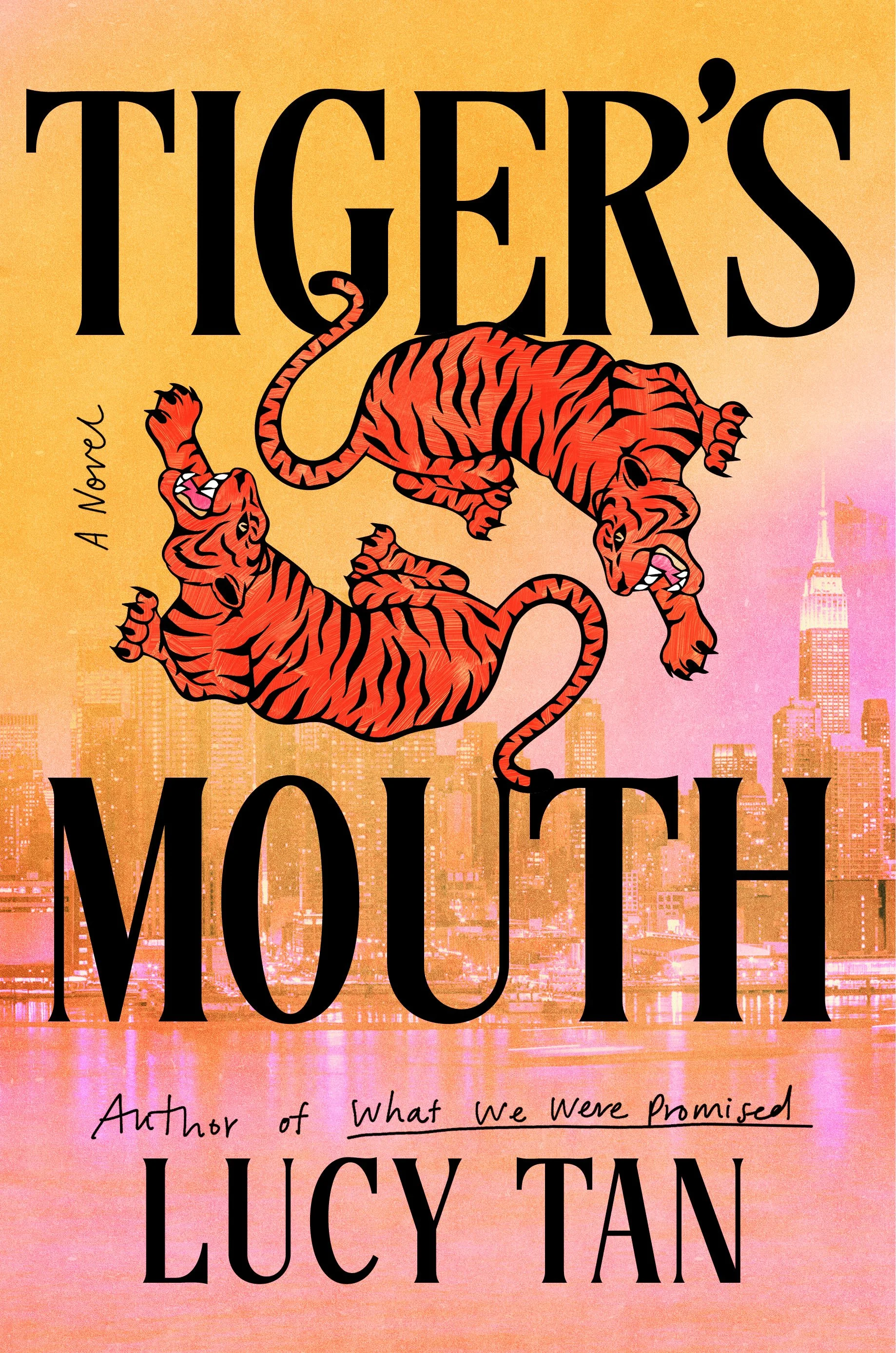
TIGER’S MOUTH
WRITTEN BY LUCY TAN
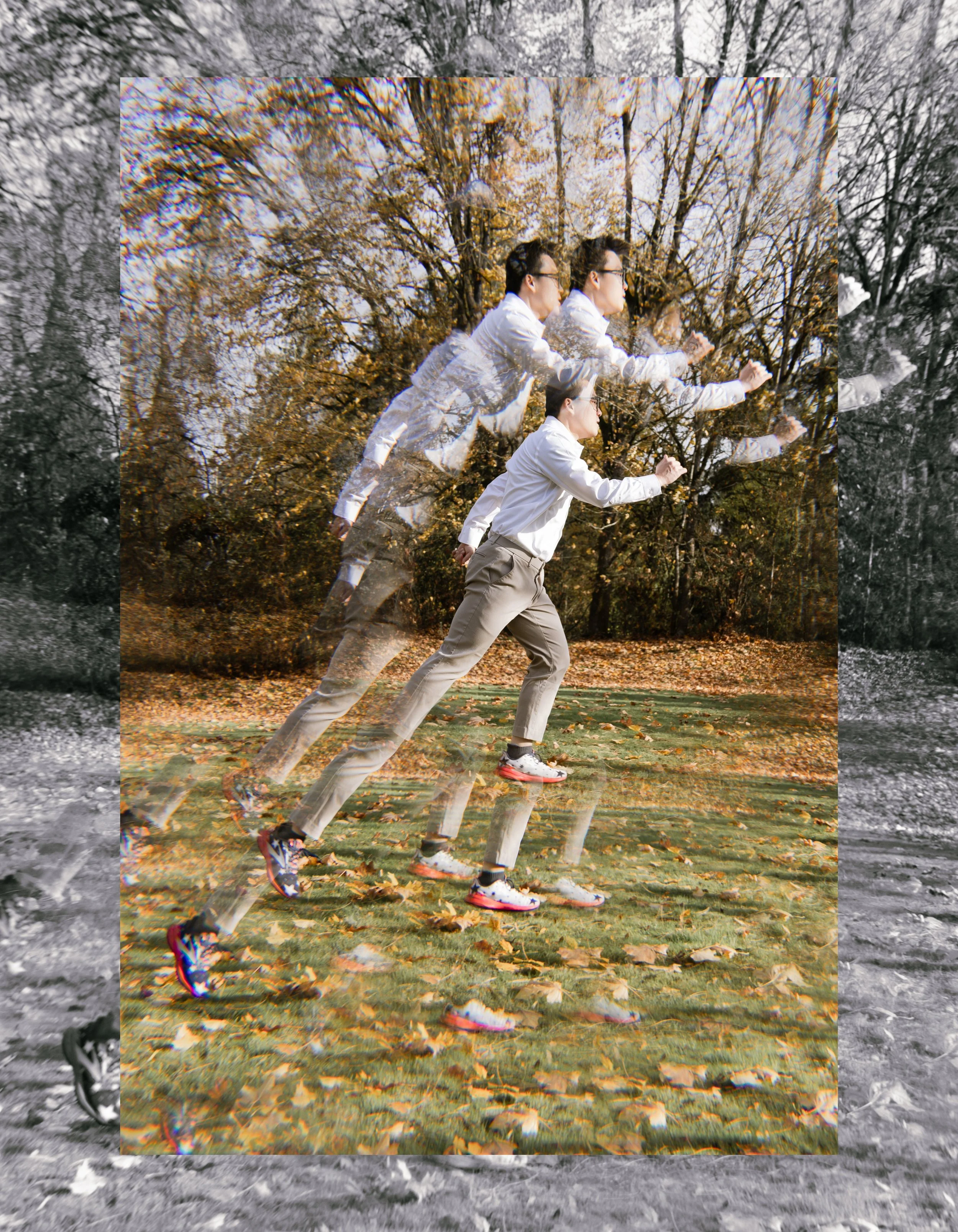
PHOTO ILLUSTRATIONS BY CHARISSA SORIANO
The following is a CHUM-exclusive sneak preview: the opening chapter of Tiger’s Mouth, a novel by Seattle-based writer Lucy Tan, slated for release on November 17, 2026.
Four weeks before graduation, an interloper slipped through the side door of Columbia University’s Lerner Hall. In the darkened lobby, a guard winked and nodded him through the swing gate. His steps quieted as his heart gained momentum, and he reminded himself to breathe and to tighten his tie. Though he was a frequent visitor by imagination, it was the first time he’d arrived in this building on foot. No time to linger and take in his surroundings, though he itched to do so. He was carried along by a crowd of students and parents into an auditorium filled with long booths bearing the banners of tech firms, investment firms, and consulting firms, most of which he had never heard of. He scanned the room until he saw the name he was seeking.
“Jack,” he said, when it was his turn at the table. He stuck out his hand. “Jack Chen.”
The company rep at K.O. Systems was taken aback when the boy in front of him laid on the table a briefcase whose leather was peeling at its corners, and pulled from it a résumé printed on ivory card stock. The kid smelled of cigarettes and hair gel, and he had CUNY written all over him — a pierced ear, ill-fitting pants, the briefcase clearly extracted from the depths of a bin at Goodwill. But he wore a smile so confident you’d think he was a Rockefeller.
“You don’t go to Columbia,” the rep said, looking up from the page.
“Well, K.O. Systems doesn’t recruit at City College. I’d like to work for you this summer. As a software engineer.”
The rep raised his eyebrows and scanned the résumé again. There was nothing of note on it — years-long part-time work at a catering company, one-off gigs painting apartments in Queens. A full two-thirds of the résumé was under the heading “Personal Projects,” a litany of coding languages and descriptions of self-made programs.
“How’d you even get in here?” the rep asked.
Chen shrugged. “Getting in here is about the easiest problem any one of your deserving interns could hope to solve.”
It was slick, too slick to be convincing. The rep felt that this kid was grasping at straws, but also that he might be the kind of person who grasped so often he ended up with a handful of them on any given day.
“I don’t have a Columbia degree, but I have something other students here don’t.”
“What’s that?”
“Sir, I’m used to testing boundaries.”
“You mean breaking the rules?”
“No. I mean breaking systems. I mean redesigning them so they work better. If you give me a moment, I can explain some of the projects I’ve done and how they might pertain to your business.”
The rep narrowed his eyes, took a sip of his coffee. He worked in sales; he knew nothing about computer programming. “And why is it that you want to work for us? Specifically.”
“Well, sir, you have one of the highest-paying internship programs in the city.”
“Points for honesty, I guess,” the rep said with a laugh.
“What I mean is I want to work somewhere that has a lot of resources. Money means broader opportunities and room to grow. K.O. Systems—”
“Our list of engineering applicants is full. We only offer so many interviews each summer, and they go to the top-scoring students at Columbia, names sent to us by their professors.”
The rep glanced over the boy’s shoulder. A clot of students had formed behind him, waiting their chance at a conversation. Still, Jack didn’t move.
“What about in Dev Ops? I read in the news that you just received another round of funding. You’re going to need more people to expand, right?”
It was clear that the kid had drive as well as a certain foolhardiness. He was the kind of person who would either end up making a huge success of himself or fall flat on his face. Both outcomes were intriguing. The rep looked at his clipboard. “I can get you an interview in” — he flipped to the sign-up sheet with the fewest filled slots — “data analysis.”
Jack grinned. “Data analysis was my next choice.”
If the rep doubted him, he didn’t show it, just wrote his name down and placed the ridiculous résumé in the stack with the rest. But after the kid left, after the rep finished talking to a dozen or so other forgettable students, their conversations dull and rehearsed, their faces soft with inexperience, he picked up the clipboard again. He turned to the list of engineering candidates and drew an extra line beneath the last name on it. There, he wrote: Jack Chen.
It was on this list Chen’s name stayed, at first in a handwritten scrawl, then typed up by an executive assistant, then spoken into the phone by the HR representative who called him in for a technical interview, and finally read aloud by a receptionist into the monochromatic lobby of K.O. Systems where he waited for his follow-up interview. When he passed it, was offered the job, and announced the news to his family and to his girlfriend, Caty — with whom the first blush of romance had worn into a persistent, achy obsession — he felt as though he were introducing himself as someone new, and yet someone he knew he’d been all along.
Chen’s parents were caterers. On weekends, they donned their cleanest whites and pushed rickety tray racks of food through back entrances of hotel venues. He had grown up peeking through kitchen doors to the cavernous crystal-and-china world beyond. He knew that the side door was often the only way in, but where he went from there was a different thing entirely.
Once, during a catered event, he’d walked right into the ballroom like he’d belonged and pulled up a chair next to some unsuspecting auntie, who looked at him and saw simply a child who needed to be fed, not a party crasher. Chinese gatherings were big and raucous, porcelain and crystal or no. An unaccounted-for child always got the benefit of the doubt and a full plate of food. He was able to get in a few bites before he was spotted by a server and hauled back to the kitchen.
“You’re so like your great-grandfather,” his popo scolded him when he arrived home in the fug of his parents’ disapproval. “He was a shape-shifter, too.”
“What do you mean by ‘shape-shifter’?”
“He had the ability to blend in, become whatever kind of person people thought he ought to be.”
Jack’s great-grandfather had gone missing during the Japanese occupation. It was rumored that he’d turned into an informant.
“I’m not a shape-shifter,” Chen said. “I was just hungry.”
“It’s a blessing and a curse,” his popo replied.
Jack hadn’t lied — he had been hungry, but it was a kind of hunger that wouldn’t have been sated by a skim off the wok already on the burners. He was hungry for the expansive room, the sound of the ladies’ swishing skirts, and the luxury of time to sit and eat and watch other people bustling around him while he got to sit still. Not in anyone’s way, but in the center of it all.
At age ten, Chen was riding the subway home from the Bronx Zoo with his popo when he saw a group of teenagers board the train dressed in crisp white shirts and navy cardigans in a style like the ones his grandfather had once worn. They were incongruous with the brightly patterned backpacks slung over their shoulders. These kids formed a small circle by themselves, speaking of nothing Jack could ascertain. One boy pulled out a bouquet of rock candy lollipops and passed them around to his friends. They sucked as if not tasting the sweetness at all, which somehow made the candy seem more rarified. The teenagers all had clear skin, their hair ranging from dark blond to tawny brown, a kind of lightness and softness that caught the afternoon light as easily as the candy they were holding.
“Who were those kids?” he asked Popo after the group got off at 81st Street.
“Private school students.”
“What’s private school?”
“It’s for rich people.”
The image of these students lingered in his mind, and after that, he began to look for private school students the way boys his age who grew up in the suburbs might look for warblers and blue jays. Each time he saw school uniforms on the train, excitement came over him. These kids were treasures in the wild, a completely different species than he, with the ability to flit between his habitat and their own.
In the eighth grade, his counselor told him that his grades were impressive and suggested that he apply to magnet schools. Despite the lack of uniforms on the kids pictured in the brochures, he liked the idea of being accepted somewhere exclusive. It was about as close to those private school students as he could ever hope to get. When he was admitted to Townsend Harris High, his parents lit up with unexpected hope. It was the first time they approached Jack’s prospects with any long-term consideration. Their younger son, Ivan, had Down syndrome, and required the majority of their parental attention and care. To keep their older son fed and clothed was enough, but now they saw him as someone who could not only fit into the world of their catering business but move beyond it. Jack happily took up this mantle of hope.
At Townsend Harris, there were computer labs and art rooms stocked with boxes of oil pastels that were not missing any of their colors. Best of all, he took a computer science class, where he fell in love with the kind of language he must have spoken in another life. To create something out of nothing with just strings of letters and numbers made him feel like anything was possible. When he stared at that dark screen and filled it with code, it was like he’d gone deep into space, where nothing — not even gravity — could hold him.
As a junior, he decided he wanted to go to Columbia University and attached to it the same glamor that he once had to private high schools. His counselor thought he stood a good chance; all he needed was to ace his boards, which his grades showed him completely capable of doing. But the SAT wasn’t like any test he’d ever taken. He found himself distracted by word problems (What was a regatta and what did it have to do with the speed of a boat?) and unable to concentrate on reading comprehension, confusing the names of European cities and cheeses in an essay about dairy farming. His score, after multiple attempts, was middling.
And so came Jack Chen’s initial splitting of self, his first true act of shape-shifting. He felt himself divide into two: the person he aspired to be and the person he was. With his scores, he knew that Columbia was far out of reach. Besides the disappointment of his eventual rejection was a shaking of the core belief shared by his family that Jack was brilliant. Here was incontrovertible proof that he was not. But how do you break that news to your loved ones, who have staked their hopes on you?
The answer was you became a performer. When your rejection came from Columbia University, you told them you got in, and the smiles on their faces made you feel as if you had gotten in, a lie — a life! — that felt so real to you, you almost let it go on forever. But you didn’t get carried away, you pulled back from the edge just in time. After a week of celebrations with them, you put on a sad smile and showed them the acceptance letter from CCNY with the full scholarship. You told them that you had to be practical and take the entire picture into consideration. You couldn’t justify paying full price for Columbia when four years at City College were being offered to you for free. You were not going to let yourself be saddled with debt, or make your parents spend any more money on you than they already had. Everything they made was going straight into retirement. And the more you spoke, the more you knew you meant it. Your mother’s hands were raw and scarred from handling hot food; your father had a bad back and needed a new bed. They were forty-nine going on a hundred and two. They were not under any circumstances to think about providing for you.
Growing up, Jack hadn’t always been the most dutiful son and brother. Sometimes he liked to go missing. He slipped away in crowded streets and at neighborhood functions, where he mingled with strangers or walked silently by himself, pretending to be someone else — someone who was part of a different family. After school, rather than joining Popo and Ivan where they waited for him by the gate, he lingered behind the big metal doors, watching them and considering his options. He might board a bus into Manhattan, or escape to Steve’s house for N64. He might go to Dintai’s to pet the new litter of puppies, try to offload them in the park for cash. When Popo grew visibly impatient, he continued to wait. It was Ivan’s expression he was watching for: that moment when his brother’s un-ease would turn to panic. Only then would Jack emerge.
“Here I am!” he’d say as he ran up to them, and watch Ivan break into a grin that turned Jack’s insides to honey.
Jack might never be able to command his parents’ full attention, but he was certain he was the center of Ivan’s world. This feeling of indispensability was the only thing better than freedom. When Jack was around Ivan, the world seemed simpler, and it was much clearer what his priorities were, what he should do. In these moments he felt least like a shape-shifter. Around Ivan, he could feel himself becoming solid.
Lucy Tan is author of the novels What We Were Promised and Tiger's Mouth. She also works as a bookseller at Secret Garden Books in Seattle. You can pre-order Lucy’s latest novel, and celebrate the book’s release at Folio (93 Pike St #307) on November 19.
Charissa Soriano is a Filipina documentary photographer, visual storyteller, and interdisciplinary artist based in Seattle. Through photography and mixed media, she explores immigration, identity, memory, and belonging, often focusing on quiet, intimate moments that reveal what is unseen. Check out CHUM’s interview with Charissa.
The except above is from the book TIGER’S MOUTH by Lucy Tan. Copyright © 2026 by Lucy Tan. Published by Ballantine Books, an imprint of Random House, a division of Penguin Random House LLC. All rights reserved.