

REAP WHAT YOU SOW
Mixed-media artist Yaminee Patel’s debut solo exhibition uses rice, lentils, and beans to celebrate the communal strength found in food. Local restaurants, food orgs, and advocates helped make it all possible.
WRITTEN BY MEGHNA JARADI
PHOTOGRAPHY BY XANDRA YUGTO
You can tell where a person of the global rice-eating diaspora grew up based on the rice brand they ride hard for. For Yaminee Patel, a Seattle-based mixed-media artist whose solo exhibition, “Rice, Roots, and the Road to Cultural Exploration,” opens tonight at Common Objects in Belltown (2601 1st Ave), that brand is Royal Basmati. It’s mine, too, as it is for many Indian Americans: its long grains and iconic brown burlap bag are a grocery haul go-to.
Ahead of opening night, Patel walked me through the rich diversity of rice varietals Seattle eaters consume (Elephant brand-loving Canadians, we see you!). Some of those grains show up in her artwork. Think intricate pastoral landscapes made of lentils, chickpeas, beans, and rice from around the world; a rice cooker made out of black rice; a sari; a “quilt” woven from the bags of over two-dozen distinct brands; and many more thought-provoking pieces.
Starting with the abundant pantry goods her parents sent with her from Ohio back to Seattle, Patel began to design 2-D, then 3-D works (like a functional pair of overalls made of rice bags), and then turned to local peers as she contemplated next steps, culminating in a remarkable display of creative process: absolutely worth an in-person visit.
Paired with politically aware, informative programming (more on that below), the exhibition also pays homage to the local food-focused community that Patel has tapped into. A dynamic ecosystem of restaurateurs, community pantries, and food-access advocates chipped in with grains and feedback, helping make Patel’s work as varied as it is.
Patel’s process reminds me of one of my favorite poems, “The Way It Is” by William Stafford. Stafford’s poem affirms the tenacious, sometimes non-linear pursuit of purpose. Yaminee is clear-eyed about the years-long thread underlying her work: Very little happens without the effortful and necessary work of community building.
“Rice Farmer” is striking because of the way Patel depicts stillness in a rice paddy.
When Midwest-raised Yaminee Patel moved to Seattle in 2021 for a food developer role with Amazon, the conditions for experimentation were ripe: “I want[ed] to rebuild and try something completely new… without any preconceived notions of what I'd done before.”
Because of the in-betweenness we occupy, a task implicitly handed to the kids of immigrants is to develop an “authentic” and grounded relationship to personal heritage. Parents Alpa & Kishor Patel inadvertently lit a creative spark when they sent Yaminee home with copious amounts of rice and daal (lentils). Her extended family is still actively farming and cultivating rice in the Indian state of Gujarat today; phone calls with them informed her knowledge of cultural practices. Patel then started using grains in illustrations of everyday life in rural Gujarat, memorializing her own path to understanding.
“[I thought] so deeply about how hard it is to actually make rice,” she said. “The fruit of that labor is… so coveted that it's used for religious ceremonies to show the prosperity and luck and joy in the process of getting married or other transitional phases in your life.”
Patel’s impressionistic pièce de résistance, “Rice Farmer,” is part of that reflective strain of work. It’s striking because of the way she depicts stillness in a rice paddy: Amidst slender green shoots, a woman in loose, beige clothing is mirrored by shallow water. That sense of calm belies the tedious process of the work’s assembly. It took four hours and four bottles of Elmer’s glue to place each intentionally unpainted lentil, chickpea, mung bean, and grain of rice on the 24’’ x 36’’ canvas.
The project has broadly been a “good forcing function to slow down,” Patel said.
She transitioned to 3-D work after an upcycled rice bag fanny pack at Mixed Pantry in Belltown inspired her to make a few of her own. When her parents caught on to the budding sewing project, they were more than happy to tap their extended network for source material. That ease surprised her:
“I think in the past, communities have been so comfortable asking for help and support that anything as simple as, ‘Hey, my daughter is doing this weird art project. Can I have your trash?’ was not a problem,” she said. “For me, I've always struggled with asking for help. I think a lot of us do: We really rely on independence and doing things ourselves. So I wondered if I could just literally go back to Seattle and be like, ‘Hi everyone. Can you give me a bag of rice?’”
It marked the beginning of what she refers to as self-induced “exposure therapy.” As it turns out, asking allows others the opportunity to meet you, and make your life better the process. “I feel like people are now comfortable asking me for help, and I think we need more of that,” she said.
Bags of rice came in from family, friends, and some of Seattle’s best-loved local restaurants.
After sending off a flurry of info cards and DMs, bags of rice and pulses came in from family, friends, and some of Seattle’s best-loved local restaurants: OHSUN Banchan, Med Mix, and Desi Pizza Kitchen, among others. Chaat superstar Spice Waala doesn’t have rice on their menu, but they referred Patel to industry peers that did. Capitol Hill newcomer Cafe Lolo, known for its work with local farmers, also lacked rice, giving her some hyper-local grains instead, including buckwheat, farro, and millet.
PennyMarie Curry from United Way Benefits Hub at North Seattle College (a one-on-one student-assistance program) saw a flyer Patel posted in a coffee shop, and saved her a small mountain of sturdy 20-pound bags. “It was hard to get them back on the light rail,” Patel said. “They were so heavy!”
Left with a diverse stock of empty bags, Patel combined them into a “quilt” that reflected the many places where rice is grown and eaten. (Four billion people eat rice every day, she noted.) The differences and commonalities among rice-eating cultures is doubly apparent when reading “Fuck ICE, Eat Rice,” a zine and community cookbook created for the exhibition by Colorado-based activist Hue Helen Nguyen. Proposing a slate of political changes in the name of “tast[ing]… true liberation,” the zine features recipes from cultures spanning the globe, from Alaska to Palestine. Patel contributed a recipe for Gujarati khichdi (a rice-lentil-turmeric comfort-food staple); the collection also includes three versions of “classic” red beans and rice that could make for a tasty, nuanced side-by-side comparison.
Patel credits her friend Simran Rai at Revolutionary Grains, a local food-justice non-profit, for helping her consider why we eat rice, and how our more corporate and dis-located eating habits differ from those of our ancestors. “I think it's forcing me to look more at things like what I'm making, how I'm cooking, and also how I want to support these systems to make them more resilient over time,” she said.
Friends are also shaping several free gallery events to support Yaminee in celebrating rice’s communal roots: a Rice 101 workshop with Shri Repp of Indian food blog Moon Rice on Saturday, May 16; a community rice potluck on Tuesday, May 19; and an open-mic night hosted by Ashna Med on Friday, May 29. An abundant future seems to depend on asking others to help out; you can show up too.
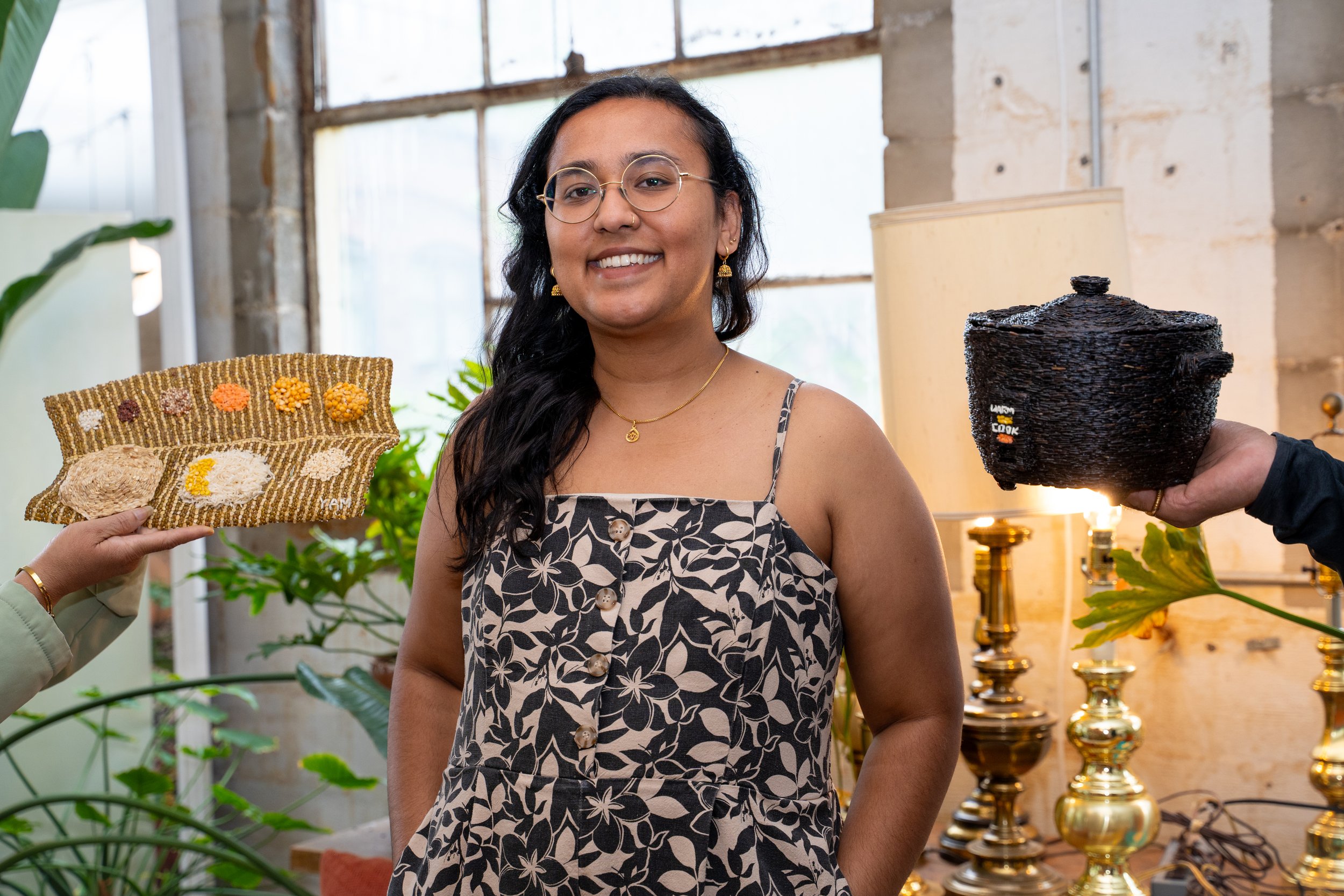
Yaminee Patel’s debut solo exhibition, “Rice, Roots, and the Road to Cultural Exploration,” opens tonight at Common Objects in Belltown (2601 1st Ave), and is on display through May 29. The exhibition’s program calendar can be found on Yaminee Patel’s website.
Meghna Jaradi is a Seattle-based food writer and the founder of Thali Creative, an interdisciplinary food-focused creative consultancy.
Xandra Yugto is a Filipino-American filmmaker and visual storyteller. Browse her website and Instagram.