

“IT’S LESS OF A ‘WEST WING’ VIBE.”
WITH MILLIONAIRES TAX ON THE TABLE, YOUTH ACTIVISTS CONFRONT OLYMPIA’S POWER ELITE.
STORY BY BRANDON BLOCK
PHOTOGRAPHY BY THE WASHINGTON BUS
Editors’ note: CHUM News, throughout its storied history, has bravely taken the position that the youth are our future. It is in keeping with that ethos, rather than a desperate bid by this publication’s aging millennial editors to retain a veneer of cultural relevance, that CHUM dispatched reporter Brandon Block on February 9 to tag along with over a dozen high-school- and college-student activists from across Washington state as they converged on Olympia for an annual day of lobbying and legislative power-brokering. The event was organized by The Washington Bus, a nonprofit focused on youth political engagement, and featured a literal bus ride down to the Capitol. (CHUM provided disposable cameras for those interested in chronicling the day from their perspective.)
The activists lobbied for measures to keep guns off playgrounds, and to keep masks off federal agents’ faces. But no bill generated more buzz than the ‘Millionaires Tax,’ an effort by Democrats to balance the state’s unwieldy tax code, and counteract Trump-induced cuts to federal funding, by tapping its highest earners.
Our reporter followed youth activists across the Capitol as they honed their messaging in favor of the tax, reflected on their paths to politics, and met with lawmakers on both sides of the aisle. In the spirit of bipartisanship, the offices of both Democratic and Republican state senators barred Brandon’s entry to meetings alongside the youth activists, which bodes well for the state of government transparency in 2026.
Brandon brings us this chronological report.
7:30am –
While waiting for the bus, I join some students on a coffee run. I ask a tall student with swoopy red hair if his scarf is University of Washington (UW) colors. He says it is. He says his name is Dylan and he’s a sophomore and chairs a committee in the student senate. Dylan talks fast, wears a peacoat and dress shoes and seems very adult. He asks about my job, which I feel ill-prepared to talk about at this hour, or any other. I say I’m a freelance journalist. He asks how that works out financially. I excuse myself to order coffee.
7:45am –
The bus leaves Capitol Hill and heaves down Madison Street to I-5. The sky gets brighter without the sun seeming to have been involved in any way. I sit down with Dylan (last name Bianchi) and Towa Nakano-Harris, another UW sophomore dressed in business-casual garb and studying a list of 14 bills on her laptop. Towa and Dylan say they are both interns with the UW student association’s Office of Government Relations, and plan to hit the Capitol again tomorrow as part of an event called “Huskies on the Hill.”
Towa’s political origin story begins in her hometown of Enumclaw, which she describes as an insular town populated by families who all know each other. COVID-19 first punctured her conservative bubble: She noticed that only her mother, who immigrated from Japan and works in healthcare, observed quarantine protocols. Later, meeting students from wealthier schools at Model UN conferences, she wondered why their college and career prospects seemed so much brighter than those of her peers.
“I would say that really, maybe not radicalized me, but it definitely lit a fire,” Towa says. “That’s a lot of the reason why I like working particularly in education policy.”
As part of their internship, they are tracking a bill that prohibits federal agents from wearing masks (Dylan thinks it stands a good chance of passing because it's “basically red meat for the left”), a bill to protect financial-aid info from ICE, and a bill calling for a federal investigation into the death of Ayşenur Eygi, the UW student killed by an Israeli sniper in the West Bank. Dylan doesn’t have a lot of illusions that the current federal administration would really look into it, but it's symbolic.
Dylan tells me that he wants to work in policy eventually, so he treats it like it’s already his job. This is the kind of advice I would have balked at when I was his age. Now it sounds like a good idea. I suspect that the only thing I have ever treated like this is watching movies, a vocation with roughly the same job density as the Swiss Guard.
“It’s less of a ‘West Wing’ vibe, you know – it’s less collegial and kind of combative,” Dylan says. “I think my interest in politics comes from an era where it feels like bigger, more dramatic changes can happen.”
When I was in college, in Maryland, I can’t remember ever visiting the state capitol in Annapolis once, or having any conception of what went on there. I tell Dylan how impressive it is that he and Towa are getting involved in state government in college. While he’s talking, I think, This is just like “The West Wing.” I ask Dylan how he got into politics, since not all people his age are so civically engaged.
Dylan says that maybe he’s biased by hanging out with student-government types, but he knows a lot of civically engaged students at his school — though some do more posting than testifying. Rewinding further, he explains that “there might be like, kind of a generational divide here.” Donald Trump was first elected president when he was in 5th grade, he says, meaning, I think, that only a fool would not engage civically under such circumstances.
“It’s less of a ‘West Wing’ vibe, you know – it’s less collegial and kind of combative,” Dylan says. “I think my interest in politics comes from an era where it feels like bigger, more dramatic changes can happen.”
“Just maybe not in a way that’s good,” he adds.
9am –
The bus pulls up the diagonal drive of the Capitol campus and rounds a bronze statue depicting young men with rifles slung upon their shoulders. It’s misting as we get off the bus and file into the Irving Newhouse Building, the newest one on the campus. During the pandemic, two decrepit houses stood here, and I sat at a rolltop desk inside one of them, writing articles about bills passed through Zoom committees. They knocked the press houses down to build this nice new building. That feels like a long time ago.
We file into a conference room in the shiny new building where three different projectors beam George Washington’s face onto screens. I take a seat between Alondra Parrazal and Richy Martinez, seniors at Eisenhower High School in Yakima. Alondra, a debater taking AP Government and sports medicine, hopes to attend Columbia Basin College in the Tri-Cities. Richy signed up for the army. He says Alondra roped him into coming.
Alondra is eager to meet her local representative, Senator Nikki Torres, to talk about SB 5098, which would prohibit the possession of guns at playgrounds, public buildings, and state fairs. Alondra says there have been two shootings at her school over the last five years. During one shooting, an older gang member roamed the hallways with a gun. “Our school is really interesting,” Richy says. Alondra and Richy debate whether a nearby high school has “more gangsters” than theirs.
10:15am –
Bailey Medilo, a gregarious WA Bus staffer and Capitol regular wearing a long black cloak and green highlights, introduces the group leaders: Lac, a high school senior from White Center gunning for NYU next year, Howell, an Eastern Washington University student, and Tre, a soft-spoken and inquisitive sophomore at Tacoma Community College.
Bailey throws the panel a curveball question: Who do they think is the “hottest” legislator – not just in attractiveness, but also in the broad sense, Bailey clarifies, meaning they’re popular and up-and-coming? Lac mumbles something I can’t hear. Howell replies diplomatically that he sees Senator Marcus Riccelli around Spokane a lot. Tre seems flustered. “Umm, there’s a lot of legislators,” he says. “What was the question again?”
Bailey briefs us on the long-awaited, big-kahuna bill of this session: what Democrats have dubbed the ‘Millionaires Tax,’ which would levy a 9.9% rate on incomes earned in excess of $1 million. Washington sits on a short list of (mostly red) states that do not tax income. Voters here rejected personal income taxes eight times over the past century — most recently in 2010 — forcing the government to rely heavily on sales and property taxes. Some rankings consider Washington’s tax system one of the nation’s most regressive, and the bill’s Democratic proponents argue that taxing higher incomes will shift the tax burden away from lower- and middle-income people.
Bailey offers some message coaching.
“Get them on notice that we don’t want it watered down,” Bailey says. “Don’t balance the budget on the backs of the poor – that’s your line.”
The tax talk sparks a conversation about money. Richy, who admits to a contrarian streak, cracks a lemon seltzer and suspects that the rich will just find loopholes. Tessa St. Prix, an upbeat senior from Spokane Valley sporting a booming mane of curly hair and who wants to be a lawyer, then a politician, in that order, replies that getting rid of loopholes is the point. Her grandma went to community college in California for free, she notes – why don’t we have that anymore? The ballooning cost of college is on her mind because she wants to go to a four-year college but her mom, who works as a waitress, isn’t sure they can afford it, and Tessa is not keen on going into debt. Her mom has encouraged her to consider community college in Spokane Valley.
“We’ve been fighting about it,” Tessa says, still smiling.
10:45am –
Snack break. Over a muffin, Alondra tells me that she recently spoke at a protest at her school in response to the shooting of Alex Pretti by federal immigration agents in Minneapolis. Richy says he thinks they should have held the protest outside of the ICE office rather than disrupting traffic outside the school. That would have endangered the protestors, Alondra counters, thumping her purse down on the table to emphasize her point. Tessa concurs. It’s not clear if this is a serious argument or if Richy is gamely offering the girls some debate practice.
All of the violence against immigrants worries Alondra. Her dad is an immigrant, and people make unfair assumptions about him. Ten years ago, when she was in elementary school and Donald Trump was first elected, she feared agents coming to take her dad away. People she knows in Yakima are now in hiding because of ICE raids, she says.
“I don’t think they should go out and assassinate people,” she says.
11:30am –
Trudging to the legislature rotunda, students hoist blazers overhead to serve as makeshift umbrellas against the pouring rain. We ascend marble stairs. Tessa snaps a picture on her phone (“I freaking love domes!”) and then gestures at a Washington State Patrol deputy perched on a catwalk above. “He’s farming aura,” she says. I ask her what “farming aura” means. She says it means trying to look cool. There is so much in this world I do not know.
“I mean, I feel like in my wildest dreams they would kill the sales tax and replace it with an income tax.”
12pm –
At lunch I catch up with Dylan and Towa, the UW policy wonks.
This is Towa’s third lobby day, and the pair reminisce about the uphill battle to pass rent-stabilization measures last session, which produced some curious testimony. Prohibiting annual rent increases above 7% would put mom-and-pop landlords out of business, Towa recalled hearing from landlord lobbyists (“the most victimized people in America”). This assertion struck her as unlikely.
I ask what they’re hoping to get out of today, since they seem so keyed into Olympia already.
“Transparently, I’m angling for the Bus fellowship,” Dylan says, referring to a summer internship program run by the Washington Bus.
Matthew Furey, a third-year UW student also wearing a tie, chimes in that he’s excited to meet with Senator Drew Hansen, whom he admires, and talk to him about the Millionaires Tax. It seems that Hansen, who represents Bainbridge Island, has reservations about the tax. (The following week, Hansen and two other Democratic Senators voted against the bill; given his district, it’s hard not to imagine that he knows a few millionaires, and perhaps sympathizes with their plight.)
“We’re a tax haven,” Towa announces.
“Our tax system is so screwed,” Dylan agrees, gesticulating wildly and brushing his bangs back out of his eyes. “It’s like an ancien régime Louis XVI deal.”
“Last year, student organizing was super on the defense,” Towa says, referring to lawmakers’ attempts to balance a budget deficit estimated as high as $15 billion. “Every time we stopped something from being cut or reduced the size of a cut, that was a win, versus making actual progress.”
“I mean, I feel like in my wildest dreams they would kill the sales tax and replace it with an income tax,” Dylan says.
Towa says that with an income tax, you could even reduce taxes on businesses.
“Right!” Dylan says, tapping his fingers on the table.
“You increase economic activity, and you’re targeting the least active and liquid wealth in the state, which is the stuff that’s just going to come in and sit in the bank accounts of wealthy people,” he continues. “I mean, it’s such a no-brainer. It's tax code 101.”
They both agree that calling it a ‘Millionaires Tax’ is good branding – a straightforward one-sentence pitch. But wait, Dylan says, doesn’t the state constitution prohibit income taxes?
“I’ve been waiting for this,” says Matthew. He pulls out a hardcover copy of the state constitution his brother bought him for Christmas. He flips through the pages. “Wow, there’s a lot of [pages],” he says. “It would probably be quicker to just look it up.”
Towa has already located a webpage on her laptop that indicates the ban on income taxes is not a constitutional statute, but a state law (“we can amend that shit”), and that a 2023 court decision has raised optimism about the legal prospects of an income tax.
Dylan turns to Matthew. “That’s a good opportunity to flex your constitution, though,” he says, comfortingly. “This is the exact crowd that thinks that’s cool as hell.”
12:30pm –
Back at the Yakima table, the conversation turns briefly to music. Tessa observes that Richy’s Instagram photo features an artist named “Laufey,” who to my great relief I have actually heard of. Richy says he prefers Kanye (“He fell off, but he’s coming back!”). Richy likes the early albums, because they relate to the struggle of “the life.” I ask him what life he’s referring to. He says the life of being in school.
“I would say: Just keep testifying”
1pm –
I huddle up with Bailey, Matthew, and Sydney Lok, a UW Bothell senior and photojournalist, in a marbled hallway outside legislative hearing rooms. Our plan is to convince a staffer for Rep. Julio Cortes (D-Everett) to pull him from his committee meeting. A legislative assistant named Charles, whose hair is gelled into small curls, walks out holding a phone and says they’re voting right now. Charles instructs us to back up from the door.
“Twice per day someone gets clomped by the door,” Charles says. “I’ve hit a rep with a door.”
Two pages wearing identical gray blazers walk by. We have to go to our next meeting, so Sydney cuts to the chase – does Rep. Cortes support the Millionaires Tax? Charles says yes. Bailey follows up: “In its current form?” Charles says probably. (As of publication, the bill has yet to reach the House of Representatives.)
1:10pm –
Freshly rain-splattered, we ride a gold-plated elevator up to the top-floor Senate Gallery. This is the big meeting with Senator Drew Hansen that Matthew was anticipating. He quickly rehearses a few facts about Hansen’s legislative record (“Could I call him a champion of education funding?”) with Bailey. A security guard brings us into a back hallway and into a small, wood-paneled office where an intern wearing a white oxford shirt and tie, who surely cannot be any older than Matthew and Sydney, vigorously shakes our hands and introduces himself as Lito. Lito reminds me of a waiter at an Italian restaurant. He gestures for us to sit on a leather burgundy couch.
Matthew jumps in. “I don’t have to tell you what a champion Senator Hansen has been for education funding,” he begins, queuing up his Millionaires Tax pitch. When he’s done, Bailey presses. “We want the senator to know we strongly support this bill,” Bailey says. Lito scribbles on a notepad and seems to be listening intently. “I would say: Just keep testifying,” Lito says. Somehow the meeting is already over. Lito gives us each another vigorous handshake on our way out. “Lemme get the door for you,” he says.
1:30pm –
We race across the parking lot to a legislative office building, past two men wearing long coats and bow ties, and ride upstairs in an elevator with more of an art deco vibe. Another narrow marble hallway. A person with a badge that says “Senate Security,” who looks even younger than our group, takes our names and disappears into a back area. Jim Walsh (R-Aberdeen), the spokesperson for the Washington State Republican Party, emerges from the back area holding what appears to be a seltzer can. Walsh and Bailey make eye contact while he waits for a highly in-demand elevator.
Yet another teenager wearing a suit emerges and leads us through the private area and into the offices of Senator Rebecca Saldaña. A staffer wearing a red lanyard greets us. We all say our names and there appears to be some confusion about my role. I explain that I’m writing an article about the youths’ trip for CHUM News. The name CHUM does not seem to garner any recognition from the staffer’s face, but the word “news” appears to trigger discomfort. The staffer says that all media interactions need to be approved ahead of time. She messages the senator from her laptop, but says she isn’t sure if the senator will respond in time.
“Would it be okay if you left?” she says, invoking that peculiarly West Coast formulation by which a demand is disguised as a question.
I briefly consider standing my ground, both because I find this kind of reflexive secrecy endlessly baffling, and because I want to demonstrate to Matthew and Sydney that the citizens do not yield their sovereignty to the elected representatives who serve them, and that – contrary to the assertions of many of WA’s top lawmakers – politicians have no privilege to conceal their internal conversations from the public simply because they deem it expedient to do so.
Ultimately I back down. We’re on a tight schedule.
Exiled to the lobby, I snoop around while Elijah, the suited intern, talks to a constituent on the phone. The act of lobbying has often seemed amorphous to me, though I feel relatively certain that my presence in this foyer qualifies only in the loosest sense of the word. I stare at the door, which now symbolizes to me everything wrong with government, and try to guess what they’re talking about in there. Light swims through a translucent door panel, but no sound escapes. I highly suspect that no great secrets of state are being shared on the other side of that door. But I can’t say for sure.
When Elijah finishes his constituent call, I ask how his internship is going. “Fast,” he says, “more emails than calls.” Then the phone rings again: “You jinxed it!” It turns out Elijah is 19 and set to graduate college next year through some arrangement where he took a bunch of college classes in high school. When he answers the phone, he says, “Senator Saldaña’s office,” whereas when I answer the phone, I just say, “Hello.” Everywhere in the Capitol I am surrounded by teenagers who seem to have more direction in life than I do.
When the secret meeting ends, the Saldaña staffer comes out and asks if it would be okay if I took the group’s photo. Begrudgingly I oblige, but when I snap the photo I tell them to say “government transparency” instead of “cheese.”
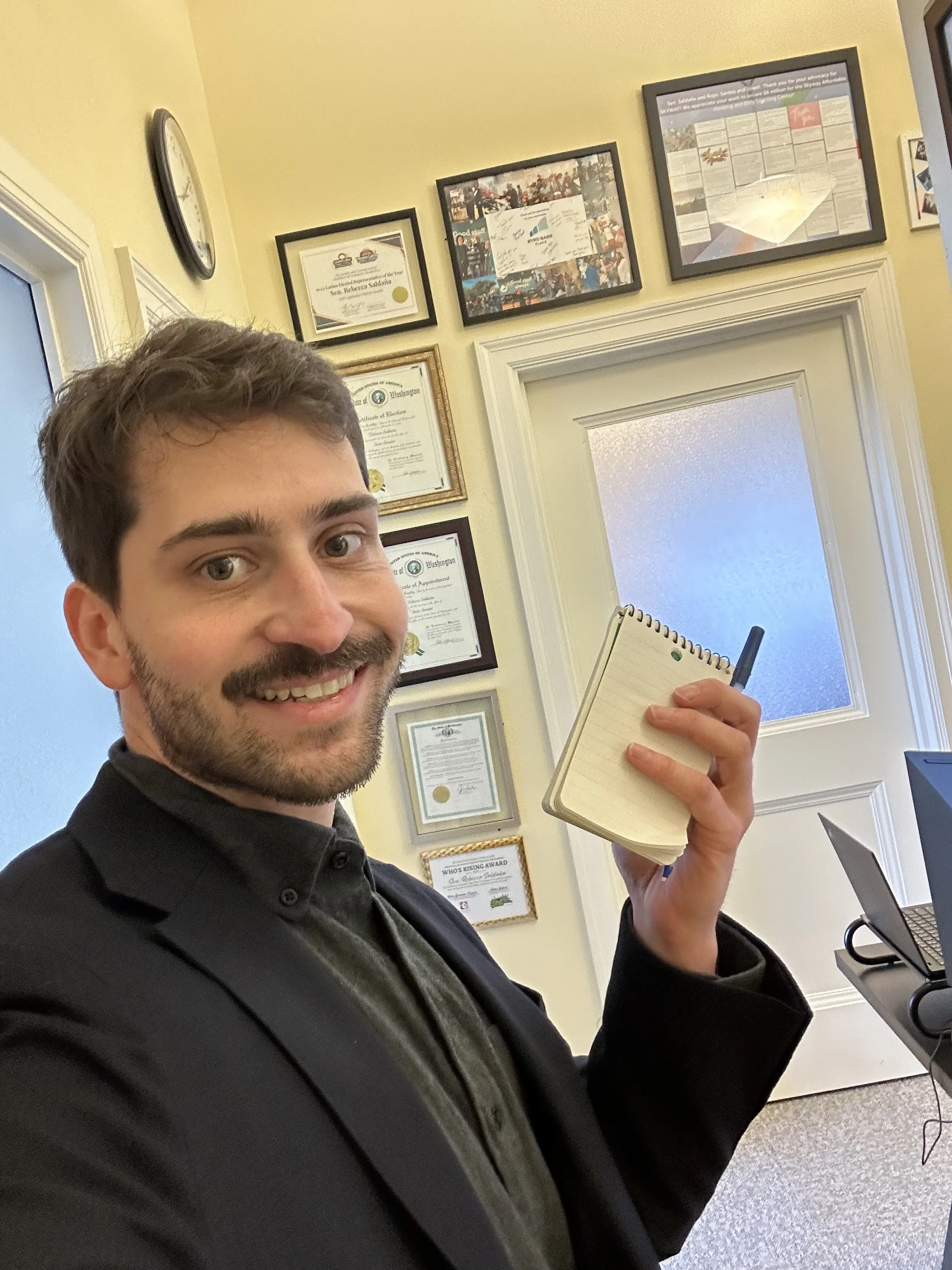
“The act of lobbying has often seemed amorphous to me, though I feel relatively certain that my presence in this foyer qualifies only in the loosest sense of the word.”
– Reporter Brandon Block, exiled from meetings with Sen. Saldaña (D-Seattle) and Sen. Torres (R-Yakima)
2pm –
Meetings finished, our quartet re-emerges to find sunshowers. Sydney, who is visiting the capitol for the first time, snaps a picture of a rainbow overhead. I ask what she makes of everything. “It reminds me of a movie,” she says. “Everyone running around and talking really fast.”
We rejoin the full group on the capitol lawn, next to an empty fountain.
Tessa, the Spokane Valley senior, tells me she felt an easy rapport with her local representatives, who spoke casually and seemed approachable. She resonated especially with Rep. Natasha Hill, who talked about the challenge of being heard as a mixed-race woman from Spokane, three identities that she shares. Tessa says she related to Hill’s comments because she sometimes feels ignored by her debate partners. Or feels noticed for the wrong reasons, like when she organized a recent school walkout to protest ICE raids, and some classmates invoked stereotypes about angry Black women.
Talking face to face with legislators also demystified the whole edifice of government, she added.
“I kinda, like, didn’t view politicians as people,” Tessa says. She quickly revises. “Like, I viewed them as people, but I viewed them as far out of touch and like a celebrity almost: They’re not quite real to you, you can’t grasp them. But once I started talking to them, I was just like, These are normal everyday people.”
(When we catch up over the phone the following week, Tessa tells me she’s working on starting a civics club at school.)
Dylan reports back that his meetings with Democratic staffers who largely share his sympathies went fine, if predictably.
Towa says she met with Senator Phil Fortunato, a Republican who represents rural Pierce County where she grew up. She appreciated that Fortunato was willing to meet with her, but noted that he “definitely dominated the conversation.”
“He had a lot to tell us,” she says, emphasizing the word tell. “Particularly about federal law enforcement – so we got a little stuck there.”
Alondra, the Yakima debater, describes a similarly ambivalent experience. Her first meeting, with Rep. Shaun Scott (D-Seattle), went well; she found him attentive and encouraging. But the second meeting, with a staffer for Senator Nikki Torres, who represents her home in the Yakima Valley, was not so great.
I had asked ahead of time to join the meeting, and a Washington Bus employee emailed Torres’ legislative assistant to ask if I could sit in. “I’d rather not have him in the meeting,” the legislative assistant replied.
(CHUM’s doggedly inquisitive editors emailed Torres’ office to better understand their diffidence, but it seems they would ‘rather not’ elaborate.)
Alondra says she lobbied the staffer on the bill prohibiting guns from playgrounds, but he didn’t seem too interested. She doesn’t remember him writing anything down, she said.
“All he said was, ‘That’s nice.’”
(Torres voted against the bill, which passed out of the Senate on a largely party-line vote on January 21. As of publication, the House has yet to take it up.)
Richy remembers the meeting a bit differently. He enjoyed pitching the bill banning federal agents from wearing masks to Torres’ staffer, and remembers the staffer taking notes.
“I didn’t see any negative [about the meeting],” he said, egging on Alondra. “She only sees the negative.”
Rather than a movie, Alondra says the day reminded her of a more prosaic experience: debate club. Even though the Torres meeting didn’t go as planned, stepping into the halls of power encouraged her to continue speaking up about issues close to home. She turns to Richy, focusing her debating energies on a target closer at hand.
“You have to point out the negative as much as the positive,” she says.
“I kinda, like, didn’t view politicians as people,” Tessa says. She quickly revises. “Like, I viewed them as people, but I viewed them as far out of touch and like a celebrity almost: They’re not quite real to you, you can’t grasp them. But once I started talking to them, I was just like, These are normal everyday people.”
Learn more about The Washington Bus on their website.
Look up and contact your state representatives through this portal. The legislative session is expected to end on March 12, 2026.
Browse Brandon Block’s website.