

DINING & WRITING
OVER DINNER AT AAMRAI, CHAITNA DESHMUKH INTERVIEWS SONORA JHA ABOUT THE LONG-WAITED U.S. RELEASE OF HER NOVEL, FOREIGN
WRITTEN BY CHAITNA DESHMUKH
PHOTOGRAPHY BY REMY STYRK
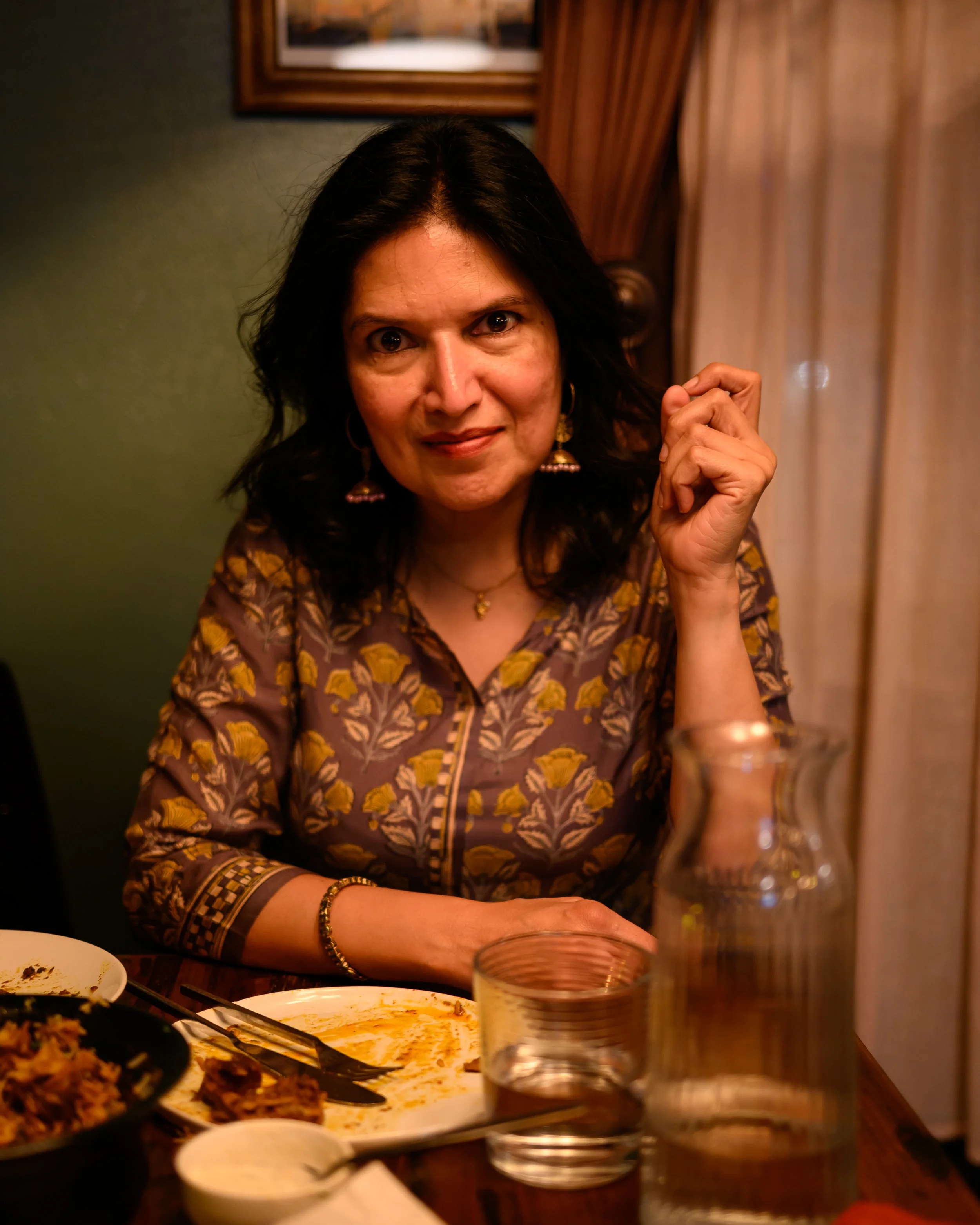
There’s nothing as intimidating as interviewing another journalist. They can tell exactly how prepared you are (or not), how experienced you are (or not), and how nervous you are (I was). But I needn’t have worried: Writer, journalist, and Seattleite Sonora Jha was an excellent interviewee, and a kind conversationalist.
We sat down together in Aamrai, a newish Indian restaurant on Bellevue Avenue in Capitol Hill, to discuss the official American debut of Jha’s first novel, Foreign. Aamrai specializes in food from the Indian state of Maharashtra, where Foreign is set. It’s also just a few blocks away from the only bookstore in America where — for more than a decade — readers could buy the novel.
With its dark wood and cozy golden lighting, Aamrai is a cozy spot tucked a little bit away from the main bustle of Cap Hill. The loud, thrumming music in Marathi and Hindi and the cricket highlights on the TV were a little distracting, but were absolutely on theme.
Foreign follows Katya Misra, a Seattleite and Indian American journalism professor, who is celebrating the publication of her own book in Seattle when she learns her son Kabir has run away from Katya’s parents’ home in India.
A professor herself at Seattle University since 2003, Jha first started writing as a journalist in India.
“Growing up in India, if you’re writing, even as a journalist, there is a huge appreciation for all the kinds of writing,” Jha said. “There’s a huge tradition with fiction writing, in English and in regional languages, so maybe I always had some aspirations, but more like a respect for that.”
Originally from the state of Bihar in northeast India, Jha’s family ultimately settled in Mumbai, in Maharashtra, when she was nine years old. Jha traveled throughout India and Singapore for her work as a journalist, before moving to the United States in 2000 to pursue her PhD in political communications.
On the surface, the protagonist of Foreign is very similar to Jha herself.
“I gave [Katya] the skeletal realities of my life, and then intensified her acerbicness,” Jha said with a laugh. “She’s me gone horribly wrong: If I didn’t control myself, if I didn’t have love in my life, if I didn’t have therapy, I would be her.”
The similarities don’t extend too far, however: Jha’s son never ran away from home, and unlike her author, Katya seems to have no love for India. Meanwhile — at least in terms of cuisine — Indian is Jha’s favorite.
“I tried to be pretentious for a while and pick others,” Jha said. “But now as I get older I can barely go four days without eating Indian food.”
Aamrai’s menu isn’t huge, and the options for vegetarian food are quite limited, but what they have is excellent. We went with the Karivepaku chicken, goat biryani, and spicy Nagpuri Saoji chicken at a level three spicy out of five, which Jha handled with ease but was about the limit of what I could enjoy.
When Katya follows Kabir to the (fictional) village of Dhanpur in Vidarbha — where Kabir has gone in search of the father he never knew — they are drawn into the lives of a family of farmers who take them in: Gayatri and Bajirao Andhale, and their youngest daughter, Meera.
Originally published in India in 2013, Foreign was borne from Jha’s experience covering the rural farmer suicide crisis in India as a journalist. Between 1995 and 2022, it’s estimated that over 95,000 farmers died of suicide in the state of Maharashstra alone, approximately 2.5 times the national average.
In the early 2000s, rural farmers in India were pushed to adopt Bt cotton, a genetically modified strain of cotton produced by the company Monsanto, allegedly due to its resistance to cotton bollworms and other pests. But because the strain is patented, farmers had to buy the expensive seeds every year rather than use what they grow.
Meanwhile, the same mutation that made the cotton resistant to pests made it much more vulnerable to fluctuations in water supply. Many rural farmers rely on rainfall, rather than irrigation, for their crops. As climate change worsens and drought becomes more common, these factors have created the perfect storm for crushing financial devastation.
Debt can drive thousands of Indian farmers every year to suicide, and many — often wrongly — believe that the government will provide restitution to and support their families.
“I interviewed all these farmers, especially women farmers, who were widows. And I was just stunned at how intense this story was, it’s such a huge global story, and there was no journalism around it,” Jha said.
Jha’s focus on how the crisis impacts women is paramount throughout the novel, exploring how their debt hurts Gayatri, Meera and other wives, widows, and daughters who are often marginalized when it comes to the story of the farmer suicides. That includes the threat of sexual violence, which some loansharks use to terrorize indebted families.
“These women were telling me these things, but they were saying, ‘Don’t put this in the story, don’t write about this,’” Jha said. “So I decided to write it as fiction.”
Despite the intensity and timeliness of the story — from 2004 to 2013, when the novel was published, Maharashtra saw an average of 10 farmer suicides every day — American publishers had no interest in the story. Eventually, one of Jha’s editors suggested she try to publish it in India instead, and about five years after Jha wrote her first draft, Foreign was finally published by Random House India.
Despite the barriers, Jha built an audience in the United States; for years, Seattle’s Elliott Bay Book Company was the only bookstore in the country importing copies of Foreign from India, and they couldn’t keep up with demand. Even with Foreign in high demand, no American publishers took the leap.
Jha moved on, publishing her next two books in the United States: The Laughter explores who gets to tell what kinds of stories, and centers a white male Seattle professor who becomes obsessed with his female, Pakistani colleague. Intemperance examines the taboo of a middle-aged woman’s desire, following a Seattleite who — frustrated with her dating life — organizes a contest for her hand in marriage based in Hindu ritual.
Ultimately, it wasn’t until Jha had published two successful novels set in America that an American publisher finally approached her for the rights to Foreign.
“The sad thing is, not much has changed with the farmer suicides,” Jha said. “Things have gotten worse over the years, and sadly the story is still relevant.”
In Foreign, Jha is honest about the devastation faced by these farmers, their communities, and their families, without the story becoming “trauma porn” or resolving with a western savior narrative. Katya is an outsider to the community, and serves as an in for the reader, whether they are Indian, American, both, or neither.
“I am not an Indian farmer, I didn’t want to write entirely from the point of view of an Indian farmer, and [Katya] becomes that Western returned gaze,” Jha said. “She’s also very Indian, and one of the things I was finding was even people in Bombay, which is so close to [affected areas], didn’t know about these farmers dying of suicide.”
“Things have gotten worse over the years, and sadly the story is still relevant.”
In the novel, many things have combined to put the Andhale family on the brink of ruin: the high price of seeds, drought, international competition on cotton prices, predatory moneylenders, and illegal dowry, to name a few.
“Just one more misfortune,” Bajirao Andhale thinks to himself, would put the family over the edge.
As an American reading the title Foreign, I assumed the novel would be about being an outsider in America, but if anything, it’s the opposite. Instead, ‘foreign’ is used mostly to describe the feeling of returning to a country that was once your home, but isn't, quite, anymore.
“One of the things I like to be, myself, is foreign. I like to exist on the margins,” Jha said. “I like to live with the discomfort, so for me it was important to show the complexities of [Katya’s] return.”
My own family is actually from Maharashtra. The fictional village of Dhanpur is near Nagpur, where my mom went to college. The snippets of Marathi are phrases I’ve heard at home, and I even share my last name with a character in Foreign. And yet, the story is not about a family like mine, or Jha’s, or even Katya’s — educated, upper-caste, urban.
As we discussed Foreign over Aamrai’s spicy Nagpuri chicken and syrupy gulab jamun, I couldn’t help but think about the farmers in Foreign, just a few miles away from Nagpur, for whom expensive chicken and sweets represented “their livelihood, not their sustenance.”
It would’ve been easy for Jha to write these rural farmers, especially the women, as simply victims. After all, they are victims — of false advertising, of nations that refuse to take responsibility for climate change we’ve caused, of a financial system that will always value money over lives. But that isn’t all they are.
“The understanding was that ‘Oh, village women are very oppressed,’ and yes, they are oppressed,” Jha said. “And yet [they are] some of the strongest leaders that I found.”
As it finally makes its long-overdue debut in the US, Foreign will find the hands of a new generation of readers, mostly American. Rather than tired nihilism or self-centered leadership, the book asks us for the kind of unselfish solidarity that Katya ultimately finds. Don’t lead fights that aren’t yours to lead, it says. But don’t give up.
Celebrate the release of Foreign with Sonora Jha at Elliott Bay Book Company on Monday, October 12th at 7pm. You can also catch her at the Northgate Barnes & Noble (Oct. 16, 5pm) and Bainbridge Island’s Eagle Harbor Books (October 27, 6:30pm).
Chaitna Deshmukh is a Seattle writer who covers local literature and public health. A former contributor to The Daily UW, she's currently a student at the London School of Hygiene and Tropical Medicine.
Remy Styrk is an Emmy-nominated and award-winning Black trans filmmaker, musician, and humanist. Remy is also the founder of the Halogen Project, which provides free photoshoots to trans people of color.
Visit Aamrai in Capitol Hill!