

THE ART PARTY
Pioneer Square’s First Thursdays project a vision of Seattle’s future wrought from its past.
WRITTEN BY JONATHAN ZWICKEL
PHOTOGRAPHY BY ABDIRAHMAN MOHAMED
“Seattle, y’all don’t know how good you got it!”
On an outdoor stage in Pioneer Square during August’s First Thursday Art Walk, Saba had a crowd of several hundred swaying and singing along. Between songs, the 32-year-old rapper from Chicago couldn’t say enough about his surroundings.
“Hella trees, blue sky, the water, murals everywhere... C’mon — there’s a waterfall down the street!”
It was a visitor’s playful nudge — and an accurate assessment. It followed six weeks of similarly wide-eyed, glowing media reports from the World Cup matches taking place a short walk away. For much of the summer, the rest of the world saw Seattle in a way locals often don’t, blinkered as we are by disappointment in the city’s problems and failures.
But right now, a new vision of Seattle is emerging in Pioneer Square. First Thursday is Seattle expressing itself in an entirely invigorated, wildly stylish image. The city’s oldest neighborhood has alchemized with one of its longest-running cultural events, and the result is a recurring celebration that feels simultaneously fresh and indebted to history.
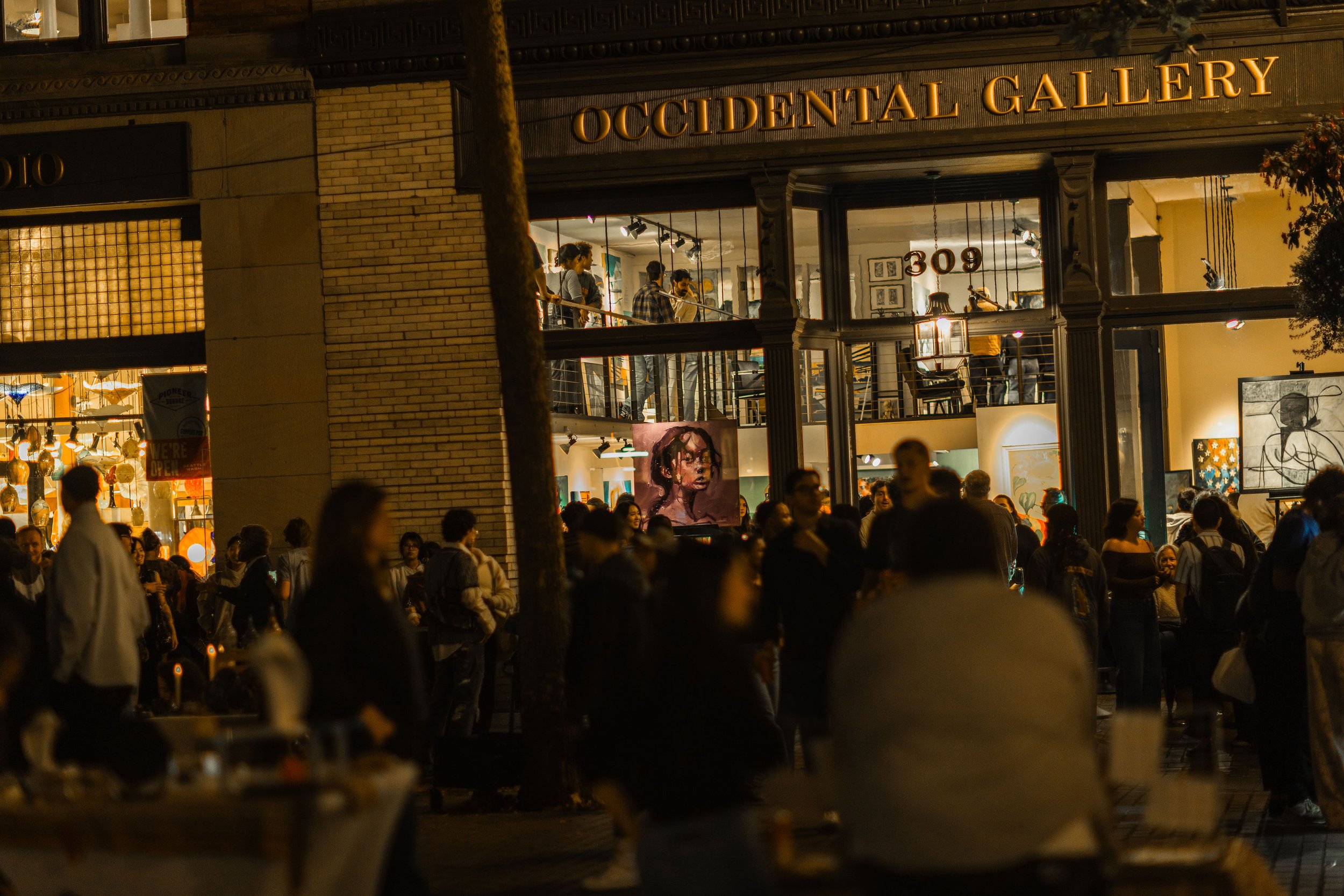
First Thursday has been around since 1979 — organizers claim it’s the first art walk in the nation — but in the last 18 months, the vibe has shifted. The copious gallery openings remain a draw unto themselves, and First Thursday has become a sprawling street party, de facto fashion show, funky night market, and debauched neighborhood bacchanal, all crammed into one five-ish-hour span. Like a well-programmed festival, it’s delightfully overwhelming, with too much to see to see it all in one night, whether you’re gazing at fine art in the museum-like galleries, browsing rows of handmade crafts and vintage clothing, absorbing live music from bands playing on random street corners and backrooms, or sitting back and watching the throngs of extremely well-dressed people of all ages, backgrounds, and orientations parade through plazas and alleyways built more than a century ago.
Countless access points for every age, interest and spending habit. No tickets, no gates, no fences. Every month, entirely free — a precious no-budget rarity in one of the most expensive cities in America. Nothing else like it exists in Seattle, and maybe the country.
This is no hidden gem: According to cell phone tracking data from the Downtown Seattle Association, almost 35,000 people rolled through Pioneer Square on the evening of Thursday, July 2: a 55 percent increase from pre-pandemic numbers. (Pristine weather certainly helps, but tens of thousands have attended in the dark months.) And yet somehow First Thursday, like Pioneer Square overall, still feels offbeat, unsung. Perhaps because it’s been here, in some shape or form, long enough to be forgotten. Perhaps because those negative preconceptions are so strong. Regardless, the energy and attendance are unprecedented.
The collective will behind First Thursday, and poured into the neighborhood in general, is coming from all directions: Big-money landlords and out-of-town developers are investing millions of dollars into infrastructure. City programs are encouraging entrepreneurs and artists to make their mark, and those entrepreneurs and artists are appealing to their audiences to spend more time and money in Pioneer Square. People are indeed showing up en masse. It’s not one thing that’s working; it is, despite the odds, a functional ecosystem making the most of our civic assets within the flawed confines of the larger city. All made very visible every First Thursday.
What’s happening here might change your mind about the Seattle you think you know. And it might point the way toward the accessible, collaborative, culturally driven city Seattle could be.
D.I.Y from day 1
Pioneer Square is, of course, the historic source of pretty much everything Seattle.
Before European colonization, the area was a thoroughfare for Duwamish and Suquamish people for millennia. In 1852 the Denny Party relocated from Alki and planted permanent stakes here; a year later, the ramshackle outpost was officially named after a local Duwamish chief, and the settler city of Seattle was born.
Henry Yesler launched Seattle’s first industrial operation soon thereafter, a lumber mill built on his namesake hill, which took on the name Skid Road for the logs careening down to Elliott Bay. The city’s first entertainment district took root here, counting more “seamstresses,” the vocation sex workers used for tax purposes, than any other American locale per capita. The nascent city burned to the ground and was rebuilt in its current incarnation here in 1889. Shortly after, Seattle’s maritime industry took off from the adjacent waterfront, the site of one of America’s most prolific shipyards of World War I, and the locus of the country’s first general labor strike in 1919.
From the 1930s through the ’70s, Pioneer Square was Seattle’s first gay enclave, back when homosexuality was criminal and bars like the Doubleheader, the Silver Slipper, and the Mocambo bribed police to ensure they could serve patrons safely; Seattle’s first openly gay bar, Shelly’s Leg, opened here in 1973. Nightlife of all kinds flourished, and throughout the ’80s and into the ’90s, a handful of grimy Pioneer Square concert venues incubated the music scene that launched the grunge boom and established Seattle's cool-guy reputation around the world.
Pioneer Square nurtured each of these key contributions before they relocated to other parts of the city. Their generative spirit seems to have been infused into the Romanesque Revival architecture that continues to attract unconventional characters and their unconventional endeavors.
The first art galleries appeared in the 1960s, beginning with what is today known as Foster/White. By the mid-’70s, more than a dozen were sprinkled throughout the neighborhood, focusing primarily on local artists, while also showing talent from across the US and Europe. These places gave a home to Seattle’s growing cadre of collectors, patrons, artists, and aficionados.
At the time Pioneer Square was a bit seedy, pocked with derelict storefronts and grungy dives. The residential headcount was low. Union Gospel Mission, opened in 1932, served the area’s unhoused population. Sports fans heading to the newly opened Kingdome would stop for a beer before game time. Believe it or not, the biggest party of the year back then was Mardi Gras. Bars and restaurants advertised weeks ahead, and brass bands, strong drinks, and rowdy behavior attracted thousands of Seattleites to the neighborhood for the night. A frisky band of young gallery owners figured they’d steal some of the shine and hosted the first Gallery Walk on Fat Tuesday, 1979. In 1980, they bumped to Thursday to commemorate the leap year. They later made it a monthly fete, and in ’84, six simpatico galleries coined the name First Thursday.
But what really put Art Walk on the map, according to pioneering gallerists Sam Davidson and Greg Kucera, was literally putting Art Walk on a map.
Throughout the early ’80s, local galleries pooled funds to publish and distribute neighborhood gallery guides in various formats. In ’83, Davidson commissioned artist Paul Porter to design the "Find Arts Map," which was shipped in the Seattle Post-Intelligencer newspaper. Members of the gallery community consolidated under several associations and continued publishing monthly guides under various titles, settling on the Seattle Art Dealers Association Exhibition Guide in ’85. For maximum reach, they shared mailing lists, which Davidson said was previously unheard of in the competitive world of art sales. By the early 2000s, they were mailing a tabloid version of the guide to more than 25,000 paid subscribers. Today, the SADA Exhibition Guide is available via email, a regularly updated website, and a monthly print edition for a $12 annual subscription.
Opening-night parties on First Thursdays were hardly staid, stuffy affairs, Davidson and Kucera said. Per tradition, moneyed patrons showed up dressed in finery, while showcasing artists typically dressed down — or dressed weird. Costumes and kooky looks were standard. Wine flowed freely, complementing other intoxicants. Photographers and videographers documented the scene. Kucera said those First Thursday gatherings could lead to a sales bump, though it wasn’t guaranteed. Equally important was the free advertisement created by a monthly spectacle. Neither gallerist felt comfortable estimating attendance numbers back then, but they pointed to those 25,000 subscribers as an indicator of widespread interest.
The self-definition, self-publishing, and self-mythologizing added up to the pre-social media version of brand building and influencing. Totally grassroots, undiluted by focus group or marketing brief, it was savvy, it was clever, and it was effective. By the 2000s, art walks had become ubiquitous in cities and towns throughout the US.
In Pioneer Square, however, momentum crashed in February 2001. That year’s Mardi Gras broke into a full-blown riot, marred by sexual violence, police mismanagement, and murder. The neighborhood took on a sinister reputation and fell into relapse. Some longstanding galleries shuttered; new galleries took advantage of vacancies and diminished rents to move in. I arrived in Seattle in 2007, and enjoyed plenty of First Thursday festivities over the years, joining intimate audiences of mostly artists and their friends.
Throughout the 2010s, massive construction projects tore down the nearby Viaduct and tore up local streets, disrupting vehicle and foot traffic with scaffolded buildings and barricaded sidewalks and intersections. Still, entrepreneurs opened new restaurants and bars, keeping some momentum as the community struggled to stay afloat. Then came the pandemic. In 2021 and 2022, First Thursday numbers stayed surprisingly robust, harkening back to pre-pandemic times. A socially distanced Art Walk turned out to be a big draw during a period of frazzled isolation. But the rest of the neighborhood — the restaurants, bars, and retail businesses — slumped and smoldered, waiting for a spark. They got way more than that.
“The artists are really what brought the people back to the neighborhood before the business sector picked back up, just as this kind of open-air gallery.”
The art party, the sneakerhead restaurant, and the biggest sporting event in the world
“As soon as they boarded up the storefronts, artists moved back into the neighborhood and started painting everything. And then people would be out on the streets walking around looking at the art again,” Dominic Nieri told me, recalling Covid-era Pioneer Square. “So the artists are really what brought the people back to the neighborhood before the business sector picked back up, just as this kind of open-air gallery.”
Nieri’s first foray in Pioneer Square was Treason Gallery, a small space known for showing edgy contemporary art from rising stars. He opened in 2015, while he was in his mid-20s, and ran it until 2017. In 2021, he began consulting for Urban Villages, a Denver-based company making a $180 million investment in Pioneer Square real estate. Urban Villages was building out RailSpur, the name they gave the half-block of three brick-and-timber buildings and attendant alleys along South King Street between Occidental Ave South and 1st Ave South. Nieri, as senior Urban Villages’ full-time Director of Curation & Cultural Stewardship, was tasked with art-ifying the site inside and out.
To fulfill his mission, Nieri reached out to the Seattle Department of Transportation, King Street Station, Pioneer Square Alliance, and even Major League Baseball. Most importantly, he drew on his relationship with Forest for the Trees, a local arts nonprofit. FFTT proposed a vast exhibition at one of the RailSpur buildings to coincide with the 2022 Seattle Art Fair, which had been taking over the nearby Lumen Event Center since 2015.
In both the art and the people on display, that June 2022 First Thursday opening-night party at RailSpur was a catalyst. It exposed a cross-section of Seattle’s bohemian class to exceptional artwork across six floors of a stunning interior architecture and design; it also exposed them to each other. Diverse in race, gender, and age; proudly, even defiantly fashionable; ready to mingle among the dramatic old bones of Pioneer Square: The template for First Thursday’s current incarnation was set.
The summer of 2023 saw First Thursday’s second evolutionary moment. The July 7 First Thursday happened to coincide with Major League Baseball’s All-Star Week in Seattle. Not coincidentally, that day Marcus Lalario was celebrating the grand opening of Hometeam, a combined Italian restaurant and sneaker shop built into the marquee corner at Occidental Street South and South Main.
Lalario is an entrepreneur whose behind-the-scenes impact on the last 20 years of Seattle culture is remarkable. He’s been involved in an absurdly diverse spectrum of music, nightlife, and hospitality projects, including running a hip-hop and drum and bass record label, managing Band of Horses, launching a burger chain that now has an outlet in Tokyo, and establishing the fine-dining scene in Georgetown. (This is a very condensed list.) He builds communities around his personal interests — Seattle sports, music, sneaker culture, fashion, food — and then finds ways for them to connect and overlap.
Lalario’s audience overlaps somewhat with FFTT’s young, diverse, and tasteful crowd, but his tenure also brings an older, in-the-know set who have followed his exploits for two decades. As a spacious, multi-use hangout directly fronting Brick Park, the name he’s bestowed on the scenic, tree-lined pedestrian zone more formally known as Occidental Mall, Hometeam adds a social gravity to the neighborhood.
From opening day Hometeam has been a people magnet, so successful that Lalario expanded his Pioneer Square footprint with a gallery space next door. And Lalario’s lengthy track record has brought him favor at City Hall, which opened the door to large-scale events in Brick Park. The calendar of shows he’s put on, both ticketed and free, has been zanily eclectic: Odezsa, Band of Horses, Seattle Jazz Fellowship, Seattle Symphony, DJ Shaquille O'Neil, RuPaul. This summer, the City fast-tracked permits to allow him to host Hometeam’s World Cup watch parties, another home run.
“I want to bring everybody down here to experience Pioneer Square and how beautiful it is,” Lalario said. “You have different demographics and different people promoting to their friends, so everybody feels welcome. It’s the oldest place in Seattle, but it’s a brand-new landscape to make it what it wants to be.”
Prior to the World Cup, partly with an eye on optics, nonprofits and business groups used a relatively unique strategy in Pioneer Square to bring houseless people indoors, lowering the kinds of requirements typically expected for access to shelter. By most accounts it worked, and is now being cited by the Mayor’s office as worthy of replication in other parts of Seattle.
Business interests won, too: Estimates put neighborhood foot traffic in June and July at half a million people, bringing almost $900 million in economic activity to the city. Hundreds of millions more saw images broadcast during local matches. The volume of coverage was unrivaled in Seattle history.
How to build a real community
Beyond the primary factors, small businesses round out the Pioneer Square ecosystem, and they’ve been jumpstarted by the First Thursday explosion. Operating a small business remains a monumental challenge in Seattle, but some here are blooming, particularly along 1st Ave South. I stopped by Frida, a fashion boutique owned by Erika Vazquez, during August’s First Thursday, and found the brick-walled, high-ceilinged store hosting two dozen people trying on chic custom creations and high-end vintage. I was offered champagne. A mustachioed stranger complimented my shirt. The vibe was exceedingly warm and friendly.
When I passed by an hour later, the store was so packed that a swarm of beautiful, impeccably dressed people had spilled onto the sidewalk, drinking White Claws and smoking cigarettes and joints. The block’s rustic architecture, lit by warm golden-hour light, framed the tableau like a Renaissance painting. Who wouldn’t want to see and be seen amid such a glamorous, rustic backdrop? Humans are very much part of the Art Walk art.
Frida, Prairie Underground, M. Gutweis, Roma, and Hoyle Hat, all located on 1st Ave South, plus Sew Generously just outside Pioneer Square’s borders, specialize in locally designed clothing for people of all genders. Along with vintage-clothing stores like the Lemon Grove and Bon Voyage Vintage, they provide the wardrobe cues for the fashionistas flocking to First Thursday. Most of these places are owned by people of color and/or queer people. Many, including Frida, have benefited from Seattle Restored, a city-run program offering grants to entrepreneurs who open projects in vacant storefronts.
“Our community is a lot more widespread than I thought,” Vazquez said. “At first I thought it was just vintage, but now it’s very much a home for people that have an interest in fashion, an interest in genuine social interaction, and also just really believe in Seattle long term.”
That long-term vision arguably extends to many of the owners of Pioneer Square’s biggest historic buildings. Lalario described Ryan Smith of Martin Smith, Inc., as "the best landlord” he’s had in 20 years of doing business. Smith, he said, was a major advocate in bringing him into the neighborhood and making big events happen in Pioneer Square.
Martin Smith, Inc. owns roughly a dozen historic buildings across the city; Ryan’s brother Greg Smith, under his company Urban Visions, owns even more. Where Ryan has been instrumental in getting Pioneer Square’s infrastructure to the point where it is now, Greg is pushing things forward. Now that the World Cup is over, some of the most anticipated developments in Pioneer Square are happening in a pair of buildings he owns: the stately Grand Central and the adjacent Buttnick, which together occupy the block between Occidental Square and 1st Ave South. The former will be a space for small businesses, galleries, and restaurants, while the Buttnick will be a 22,000-square-foot immersive performance-art experience called Nebula.
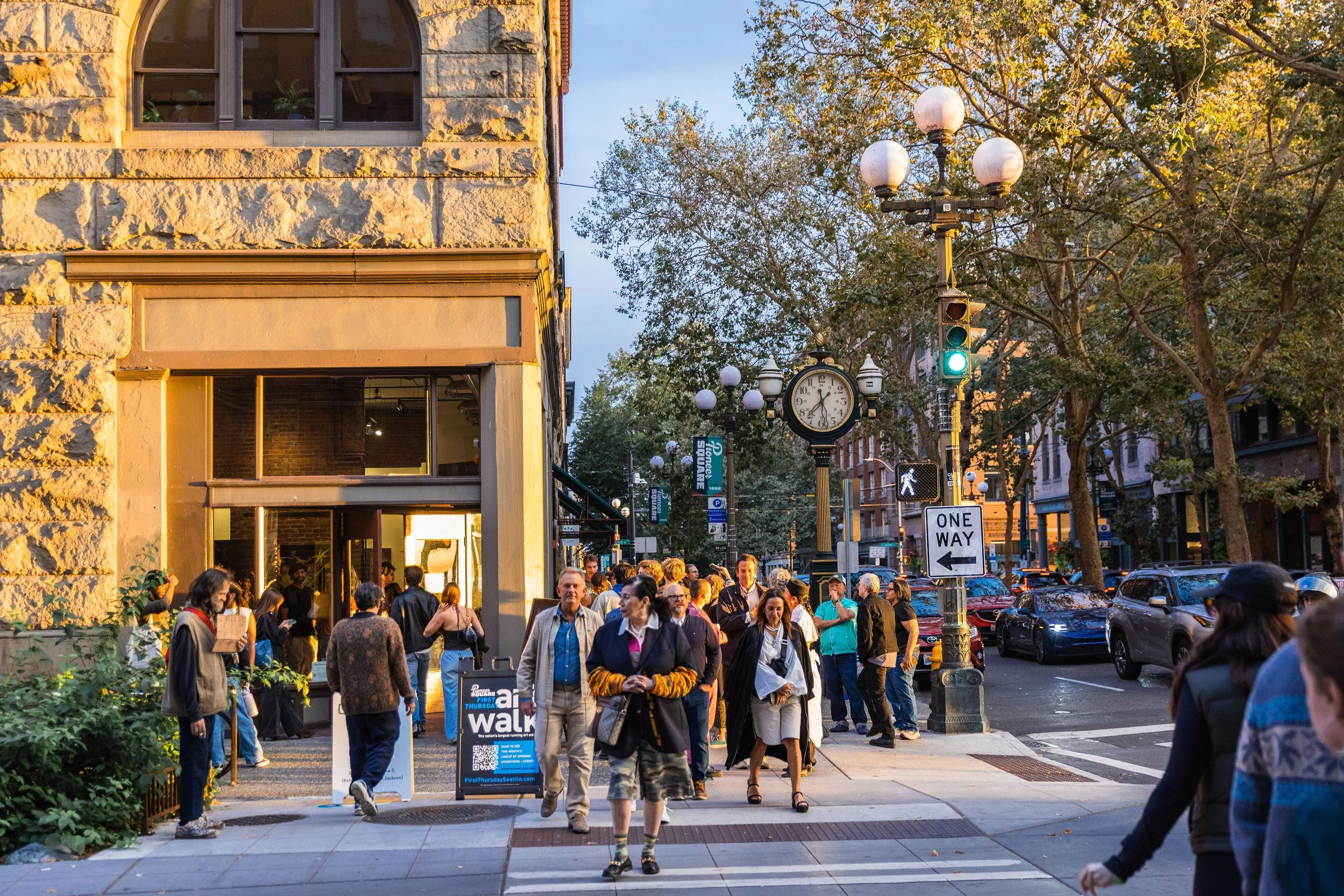
The blending of divergent demographics into one colorful urban patchwork is what makes a city feel like a city. First Thursday turns cultural miscegenation into a celebratory civic ritual.
Once Nebula opens in early 2027, co-founder and executive artistic director Erin Brindley expects it to attract 28,000 visitors a year. For Greg Smith, partnering with a local arts nonprofit like Nebula isn’t a risk as much as it is an investment, one he expects to pay dividends. Which is likely why he made the terms of their lease so favorable: ten years outright, plus the option for five more, and then another five.
“[Greg] understands very clearly that bringing in the amount of people we’re talking about is a boon for him and the rest of his buildings here,” Brindley said. “He’s our second-largest donor.”
Taken together, these developments are an ambitious, optimistic roadmap for Pioneer Square’s future. Their success depends on a partnership of public sector bureaucrats, shrewd landlords, tireless entrepreneurs, and scrappy creatives working in concert, and their success depends on people showing up. For Art Walk, and for all the other recurring Pioneer Square events such Seattle Jazz Fellowship’s extremely popular Jazz Night. To paraphrase a recent opinion piece in the Seattle Times, ideally the city will use the triumph of the World Cup as a springboard.
There have been growing pains. Lalario said City of Seattle representatives have expressed concerns about the swelling First Thursday crowds. Some want to split off separate events. “At first you’re begging me to bring people down here, and now you’re saying there’s too many people down here! Don’t come up with different ideas to market it. Just let it fucking be,” he said.
I’ve also heard about complaints from legacy galleries around the incursion of the night market, organized by the Brick Park event space 210 Seattle. Kucera and Davidson both voice concern about keeping focus on the gallery artists, who were the original inspiration for First Thursday. But a similar conflict arose in the early 2000s, and City officials negotiated a truce among galleries, vendors, and street artists that allowed everyone to coexist. This is the precedent that exists today, and given its popular status, it’s likely not changing. If anything, precedent suggests there’s room for expansion.
Davidson mentioned the resistance he and other gallerists initially felt toward the Kingdome; they worried about crowding and parking and that sports fans wouldn’t blend in with arts fans. But his perspective changed over time, until he realized that the neighborhood can accommodate everyone. Anyone who’s been to First Thursday when it coincides with a Mariners game, for example, as it did in September, knows the resulting cultural admixture is more fun than frictive.
“That’s part of the appeal,” Davidson said. “Anybody can be there and not stand out in a way that makes them feel awkward.”
Put another way: This easy blending of divergent demographics into one colorful urban patchwork is what makes a city feel like a city. First Thursday turns cultural miscegenation into a celebratory civic ritual.
The Seattle imprint
One of the more consistent comments I overheard at various First Thursdays this summer was something along the lines of, “This isn’t like Seattle! It’s more like Brooklyn/LA!”
I mentioned this to Lisa Howard, Executive Director of the nonprofit Alliance for Pioneer Square, and she rolled her eyes at what she called “this romanticizing of New York City.”
“Like we can’t possibly have that, or perhaps we’re sort of pretending we have it right now, which is a crazy mental-sociological phenomenon,” she said. “This is not a movie version of us! This is authentically us, on a weeknight. And you get to experience this next month, too. And you can come back the month after that, and, like, this is your life. It’s not something you’re viewing from outside.”
She attributed part of the First Thursday charm to the village-within-a-city feeling of Pioneer Square. Dominic Nieri agreed. His most recent project with Urban Villages, the Populus Hotel, which opened in May of last year to international acclaim for its preservationist design and rotating art collection, is part of the rising tide.
“People are saying hello. People are hanging out. People are making new friends,” he said of the neighborhood. “And it really has to do with all these organizers and curators who are just making excuses to gather — whether it’s Jazz Night or a wine walk or Art Walk. It’s a reflection of the human condition, and I think Pioneer Square is doing a great job at illustrating what a neighborhood or a community can be.”
Vazquez believes First Thursdays’ ascendance is tied to an often overlooked cultural resource that Seattle has in abundance: youthful idealism.
“I think what makes it [feel like] Seattle is the genuine curiosity of people,” she said. “People are just now finding out what their personal style is, and I think Seattle is becoming a brand new city, a different city. It’s becoming independent in its own way. I believe it’s actually going to surpass so much, and it’s not really comparable to any other city.”
Seattle being Seattle, naysayers abound. For every effusive influencer extolling the new cool of First Thursday — and there are many — for every blog post and newspaper account of new life in Pioneer Square, there's a cynical retort about crime and homelessness and litter. These detractors, who I’d wager haven’t been to Pioneer Square in ages or to Art Walk recently, can’t see the forest for the trees (ahem).
Pioneer Square boosters see a vital and enduring urban canvas. They don’t overlook the neighborhood’s problems; they recognize them as the same problems every city has. But by most measures, Pioneer Square is different. The neighborhood abides, and its complex web of interdependent relationships, a thriving village inside the city, can be a model for other neighborhoods. Like First Thursday itself, the way forward will be something only Seattle can devise.
Jonathan Zwickel is a veteran journalist who’s written for Pitchfork, Rolling Stone, The Believer, The New York Times, SPIN, and other major publications. Since 2007, he’s covered the creative community of Seattle for almost every outlet in the city.
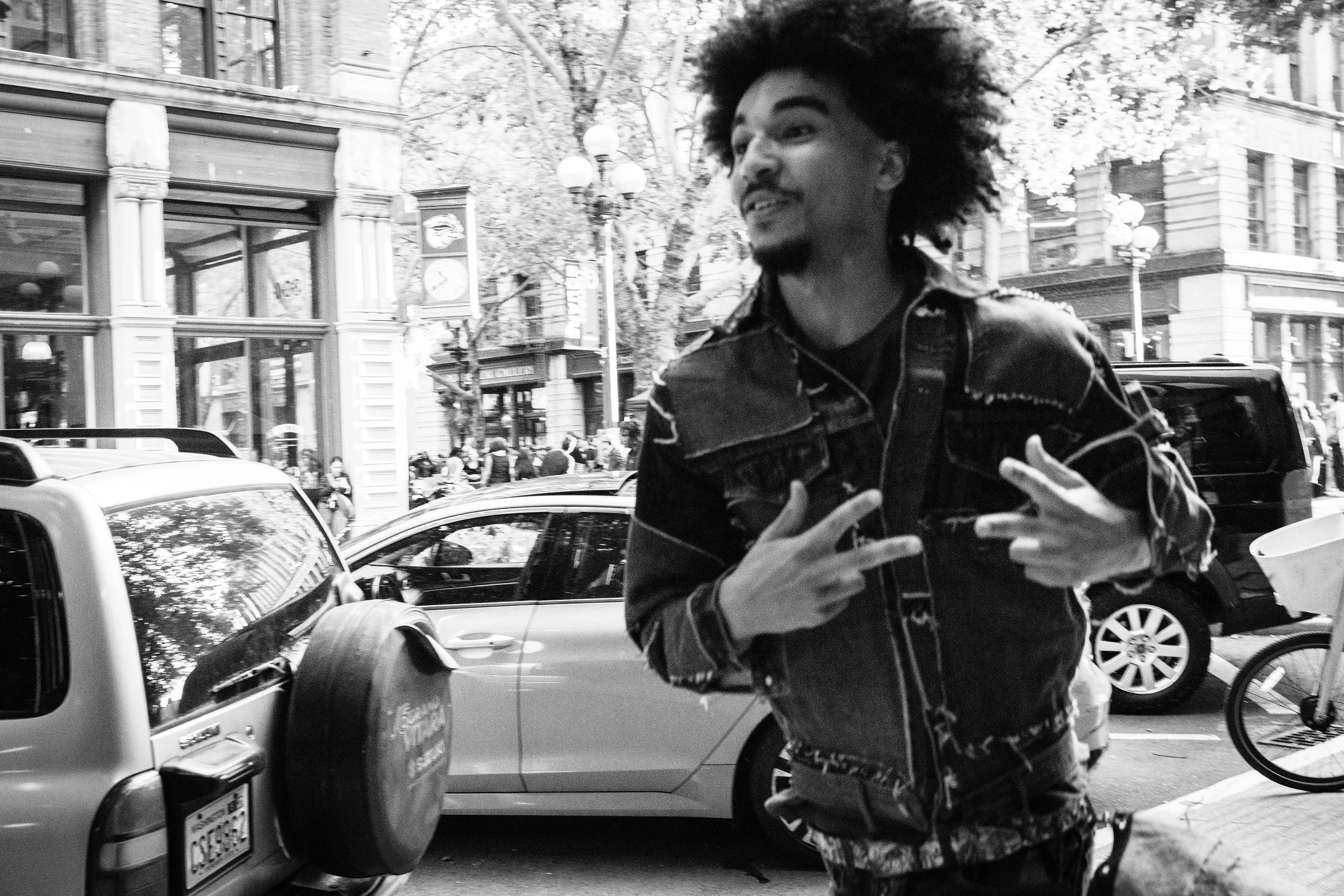
Abdirahman O. Mohamed is a Somali-born, Seattle-based multidisciplinary creative, photographer, and founder of Twodrsdwn, a branding and communication studio. Across his personal and commercial work, his photography uncovers stories hidden in plain sight, building rich context and narrative through research, process, and visual exploration.